Relic point Vietnam
Việt Nam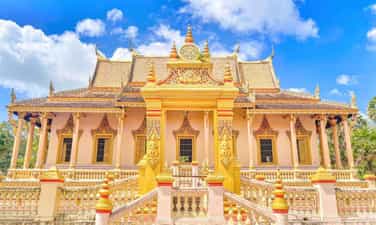
Khleang Pagoda
Khleang Pagoda is located right in the city center, located on Ton Duc Thang Street, Group 5, Ward 6, Soc Trang City. The pagoda was built nearly 500 years ago, associated with the legends of Soc Trang. The main hall of the pagoda is built on high and wide ground, the space is clear and green, especially there are many palm trees, a typical tree of the Khmer people. The pagoda has been restored many times, but it was not until 1918 that the Main Hall and Sala were rebuilt and all materials were replaced. Still an architectural characteristic of the Southern Khmer people with the dragon image on the roof. In Buddhist stories, Khmer people often say that: Dragon is a sacred animal, it turns itself into a boat to take Buddha across the sea to places to preach sutras and save sentient beings. Therefore, the Dragon was brought to the roof of the temple with the intention of hoping that Buddha would stop and save them from their damnation. Adjacent to the roof of the main hall is the image of the god bird Krud strongly supporting the roof. According to Khmer folk legend, the god bird Krud is the king of birds. In front and behind the main hall of the pagoda, there is the image of Chan standing to protect the pagoda. In Khmer fairy tales or in Du-Ke, the character Chan is a symbol of evil and ugliness, causing suffering for people. everybody. However, in Khmer visual art, Chan was conquered by Buddha. Placing the Chan statue outside the main hall implies that evil and ugliness have been transformed to serve and protect beauty and goodness. Inside the main hall is a large room reserved for ceremonies. In addition to the 12 round columns, the most important part inside the main hall is the altar of Shakyamuni Buddha statue, a 2.5m high statue placed in the middle of the two innermost rooms, not only precious in terms of materials but also in terms of sculptural art. On the altar, there are dense patterns with delicate sculptures and flame-shaped patterns that are very typical of Khmer culture. A refined aesthetic sense emerges into inspiration. Because they follow the Theravada Buddhist system, the pagodas of the Southern Khmer people only worship Shakyamuni Buddha in many different positions: meditating, newly born, begging for alms, at nirvana, etc. The interior of the main hall of the pagoda is the intersection of three cultures: Kinh, Khmer, Chinese in an architectural space, clearly shown on wooden pillars: Vietnamese lacquer art, traditional color coordination. Khmer traditions and typical Chinese drawings, creating a masterpiece that perhaps only exists at Khleang Pagoda. In addition to its role as a religious base, the main hall of the pagoda also stores and preserves a collection of Buddha statues with many different postures, sizes, and materials, likened to an ancient art museum of artifacts. These artifacts have been preserved by many generations of monks for hundreds of years, with contributions from many Buddhists. Since the beginning of the temple's construction until now, Khleang Pagoda has had 21 abbots and the current abbot is Venerable Tang No (1943). Some not only took care of building pagodas but also actively participated in revolutionary activities such as preventing conscription, nurturing famous revolutionary cadres... some had to sacrifice themselves before the enemy's guns like Dai Duc. Tran Ke An, the head monk, was murdered by enemies right in the back of the temple. Therefore, during the years of the resistance war against America to save the country, the pagoda was both a place for organizing religious activities and the most effective place for revolutionary activities of the Party. Over the years, with its important historical significance and preserved architectural value, Khleang Pagoda was recognized by the Ministry of Culture as a national historical and cultural relic on April 27, 2019. 1990. Source: Electronic information portal of Soc Trang City People's Committee
Can Tho
5356 view
Rating : National monument
Historical relic site - Location of the establishment of Tay Do Battalion
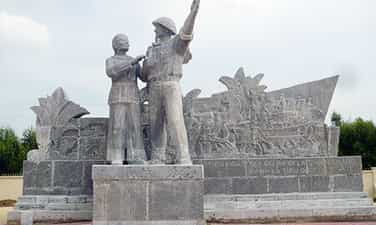
Relic Location of the establishment of Tay Do Battalion, located on the bank of Lai Hieu canal in Phuong An hamlet, Phuong Binh commune, Phung Hiep district, Hau Giang province, 25 km from Vi Thanh city, the center of the province, 25 km from the town. Nga Bay is 16 km away, convenient to travel by road and waterway to the monument. At the end of 1959, Resolution 15 of the Central Committee and Resolution of the Western Interprovincial Party Committee were implemented, and the armed forces of the entire Region were born one after another, including the Tay Do Battalion. Established on June 24, 1964 in Phuong Binh commune, Phung Hiep district, Can Tho province (now Hau Giang province). Because the Provincial Military Committee held a very solemn launching ceremony for the Battalion, with 1,000 people, officers and soldiers attending, the Provincial Military Committee had comrade Le Hoang Lau, Provincial Captain, who attended and announced the Decision to establish the Battalion. established the Tay Do Battalion, and at the same time assigned tasks to the Party Committee and the Battalion Command Committee. Comrade Bui Quang Do, on behalf of the Battalion Party Executive Committee, read the response and promised and vowed to be loyal to the Party and the people. people. Comrades shouted the slogan "Tay Do Battalion leaves and wins, fights and destroys". All officers and soldiers of the Battalion unanimously shouted "Determined victory". Born in the midst of the fierce resistance war against America to save the country, the Tay Do Battalion quickly grew up, fought heroically, achieved many resounding victories, and contributed to the liberation of the country's army and people. completely South, unified the country, fulfilled international obligations in Cambodia... was twice honored by the Party and State with the title "Hero of the People's Armed Forces". With the achievements of the Tay Do Battalion, on July 26, 2006, the People's Committee of Hau Giang province issued a decision to classify the historical and cultural relic "Place of the founding of the Tay Do Battalion" as a level relic. conscious. The relic is planned and invested in the construction of construction items such as: monumental monument, house displaying images of artifacts of the Tay Do Battalion, yard, internal roads, trees,... on an area of 01 ha The land is also in Phuong An hamlet, Phuong Binh commune, Phung Hiep district, Hau Giang province. The project was completed and put into use in 2012. It has great significance in educating the young generation about revolutionary traditions. This place has become one of the important relics of the province that is regularly opened. Serving visitors, studying, meetings, cultural activities, and entertainment of people inside and outside the province. Source: Department of Cultural Heritage Management
Can Tho
5630 view
Rating : Provincial level relics

Pho Minh Pagoda
On October 5, 2021, the People's Committee of Hau Giang province issued a decision to classify Pho Minh Pagoda (located at 135/2 Nguyen Thi Minh Khai street, area Area 1, Ward 4, Vi Thanh city, Hau Giang province). Pho Minh Pagoda was built before 1908 (before the 20th century) and is one of the oldest pagodas in Vi Thanh city. The pagoda is both a mark of religious history and a red address in two wars. resistance war against France and America, used to be a place for revolutionary cadres during the war against France and America to reside. Initially, the pagoda was only built with leaves on stilts, because at that time there were countless snakes, centipedes, tigers and leopards here. After many generations of abbots, in 1967 the pagoda was rebuilt but also made of leaves. At this time, the resistance war against America and its henchmen was extremely fierce. Meanwhile, the enemy increased military service, so many local young people voluntarily "bared their hair" to enter the temple to avoid their coercion. Since 1908, the pagoda regularly contributed rice and money to support the revolution, built secret bunkers to hide officials, and protected hundreds of local young people who escaped the military draft. The pagoda's campus is spaciously built with many beautiful and majestic statues. The campus of more than 1 hectare has a green garden, a solemn and quiet landscape, especially a quite large and beautiful lotus pond. The main hall is very spacious and spacious with many institutions such as altars for Buddha and saints; Rare drums, bells, gongs and many very ancient and culturally valuable artifacts. From 1968 to 1975, the pagoda sheltered and supported nearly 130 people. “Among these are many cases of secret revolutionary activities. Every day, they stay in the temple, but during the harvest season, they return to visit their families during the day and return to the temple at night. To protect and protect the higher-ranking officials who came to grasp the enemy situation and discuss battles, the late monk Thich Hue Giac secretly dug a shelter behind the pagoda. Not to mention, in order to deceive the American puppet, the late monk Thich Hue Giac also used bamboo bedding to surround the mouth of the tunnel, then filled it with coconut shells. Thanks to that, many times revolutionary activists took refuge here when being raided by the American puppet regime and were safely protected. On April 30, 1975, President Duong Van Minh announced his surrender, Ho Ngoc Can declared his death, and many "monks" stripped off their monks' robes to grasp the enemy's situation and continue digging fortifications to prevent a counterattack. of them. At this time, many puppet soldiers' wives and children ran to the stations to find their husbands and fathers. Seeing this, the late monk Thich Hue Giac campaigned and propagated them to advise their relatives to put down their guns and surrender. Thanks to that, about more than an hour later, the governor's palace pulled down the 3-striped flag to hang the white flag at the head of the line. After the liberation and unification of the country, the monks and nuns of Pho Minh Pagoda continued their mission of building and protecting the Dharma and the nation. During the resistance war against the US, Pho Minh Pagoda was a secret operation base, often donating rice and money to support the revolution. In particular, the pagoda is the location of secret activities of the family of former Prime Minister Nguyen Tan Dung's wife; Major General Tran Quoc Liem, Deputy Director of the General Department of Security (Ministry of Public Security); Mr. Le Viet Hung, former Deputy Director of Can Tho City Police; Security team, Vi Thanh town special forces team... Source: Vietnam Buddhist Church
Can Tho
5569 view
Rating : Provincial level relics
Historical relic site of the 1940 southern uprising, in Phu Huu
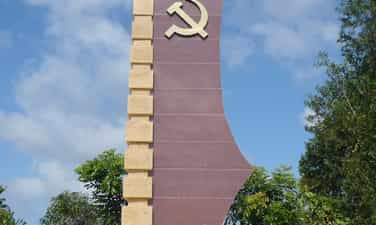
The 1940 Southern Uprising relic was previously located in Phu Huu village, Dinh An district, Phung Hiep district, now in Phu Thanh hamlet, Phu Hoa commune, Chau Thanh district, Hau Giang province. In the years 1930 - 1935, farmers in Phu Huu village lived in a situation of heavy oppression and exploitation by the French colonialists and feudal landlords. During this time, on the other side of the left bank of the Hau River, Tra On and Vinh Xuan Party cells were born and led the people to fight against rentier landlords, feudalists, and colonialists. The Party cell in Phu Huu was born and led a very vibrant peasant struggle movement and built a very good revolutionary base. From the base with the cell and the house of Mrs. Ngo Thi Lua (mother of comrades Nguyen Phuoc Ngoan and Nguyen Van Phuc) in Nga La canal, Phu Le hamlet, Phu Huu village, the Can Tho Inter-Provincial Party Committee chose as the place to locate the agency. Here, the Can Tho Inter-Provincial Party Committee has opened many training classes, many conferences of the Inter-Provincial Party Committee and printed many documents to provide for Hau Giang provinces. Under the leadership of the Party cell, the movement to fight for rent reduction, income reduction, people's livelihood, and democracy took place strongly and enthusiastically; Grassroots organizations of the Party and the masses: Youth and women opposed the empire, the Red Farmers' Association developed strongly, especially since receiving the "Uprising Outline" of the Cochinchina Regional Party Committee deployed by the Can Tho Provincial Party Committee in September. April 1940. The Party cell diligently prepared for the uprising, organized many good mass meetings to launch the movement and chose a place in the deep forest to build a hut under the shade of palm trees (hence the name "Cay Ke" hut). ) to serve as a learning and training place for young people and farmers with revolutionary enthusiasm in the village. These meetings often had senior officials such as comrades Luu Nhan Sam and Ngo Huu Hanh (in the Can Tho Provincial Party Committee) often come to talk about the situation, practice revolutionary songs and teach martial arts. The activities of the masses under the leadership of the cell, preparing for the uprising were secret but very exciting, everyone looked forward to the day the uprising would seize power. The uprising order from the Southern Party Committee arrived in Can Tho at 12 noon on November 22, 1940, but it was not until late at night on November 23, 1940 that the Phung Hiep District Party Committee received the uprising order. Although it was late, the District Party Committee still carried out the uprising. The task of the Phung Hiep District Party Committee was to organize an insurrection force to attack the district capital, attack the Phung Hiep bridge and surround and hold back the enemy from going to reinforce elsewhere. The enemies in Tra On were informed that district chief Chi sent troops to suppress the uprising. The core leaders of the uprising and the patriotic masses were arrested and sentenced to life imprisonment to five years in prison and exiled to Con Dao. Because he could not bear the imprisonment in the natural forest and toxic water, he sacrificed himself here. Although the Cochinchina uprising in Phu Huu and some places in the province did not win, because the revolutionary situation was not yet ripe, the uprising plan was revealed, so it was brutally suppressed by the enemy, many cadres, party members and The Party's loyal masses were massacred by the enemy, arrested and imprisoned. But it was an organized uprising of the people under the leadership of the Party, attacking the enemy's stronghold, signaling the general breakdown of the ruling regime. That was an important exercise, the Can Tho Party Committee learned valuable lessons from organizing the August 1945 revolutionary uprising, winning a glorious victory. The 1940 Southern Uprising in Phu Huu was recognized as a national historical and cultural relic by the Ministry of Culture and Information. Source: Hau Giang province electronic information portal
Can Tho
6256 view
Rating : National monument

Vam Cai Sinh victory relic
Vam Cai Sinh Victory Monument is located in Ward 7, Vi Thanh City, Hau Giang province. Since 1949, the liberated area of Long My district was large, a place to reserve people during the resistance war against the French colonialists, and was the base of provincial and regional agencies. In the years 1951 and 1952, the enemy suffered heavy defeats and was passive on the main battlefield, the French colonialists implemented the 3 clean policy "Burn all, destroy all, kill all", sabotaged the economy, and launched many military operations. scale of raids into our liberated area in Long My district, and expanded raids on the U Minh revolutionary base area. Implementing the above plot, the French colonialists launched a large-scale sweep campaign into the liberated areas of Long My and Vi Thanh revolutionary bases in order to destroy our forces and sabotage the revolutionary rear. Firmly understanding the enemy's intentions, comrade Huynh Thu, Captain of Can Tho Province, directly assigned the task to unit 4053, belonging to battalion 410 of Can Tho province, a unit with extensive experience in mine warfare. attacked many enemy ships on the Phung Hiep and Chau Thanh rivers. After surveying the battlefield, the enemy wanted to attack the bowels of the Long My liberated area, marching by road, the only road from Cau Duc to Hoa Luu - Vi Thanh. To prevent the enemy from raiding and raiding the liberated area, we attacked the roads and collapsed bridges on the road. On this section of road there was the Cai Sinh iron bridge. On the morning of December 22, 1952, after the enemy fired artillery to clear the way for the 14th mobile battalion, including French, Vietnamese, and Cambodian soldiers, led by a French officer, cautiously advanced into Hoa Luu commune. On the vandalized road, grass and trees are busy. At 3:00 p.m., the enemy arrived at Vam Cai Sinh canal. They gathered troops here to wait for the ship to take them across Cai Sinh canal, because the bridge was collapsed by us. True to our prediction, on the night of December 21, 1952, we placed two mines, thousands of kilograms of explosives at Vam Cai Sinh canal and sent a group of engineers (3 comrades) of Battalion 410, ready for battle. fight. At nearly 3:00 p.m., the sound of the iron train starting up loudly, coming from Cau Duc junction. Our soldiers were very calm and waited for the enemy soldiers to fully disembark the LCT (a type of troop transport ship). When the ship retreated to the middle of Vam canal to bring troops to the shore of Hoa Luu, our soldiers applied electricity and made a sound. The sky exploded, a column of white water rose hundreds of meters high and collapsed, sinking the upside-down ship into the river, nearly 400 enemies, including one mandarin Ba (captain), two mandarins Nhat (second lieutenant). ) was destroyed, we confiscated a 12 mm pistol, an operational map, two heavy artillery guns: 20 mm and 13.2 mm, 5 submachine guns, 12 rifles, completely failing the sweep plan. raided the Long My - Vi Thanh liberation base area. During the resistance war against the French on the battlefield of Hau Giang - Can Tho, the army and people of Hau Giang - Can Tho performed two glorious feats that destroyed the most enemies, which were the battle against motor vehicles at the 4 battles of Tam Vu, and the capture of cannons. 105 mm in the battle of Tam Vu 4 and the ship battle at Vam Cai Sinh canal, making the victory resounding throughout the West and the whole country. The Cai Sinh victory had an important meaning, contributing to the loss and destruction of enemy forces to coordinate with the main battlefield in the Viet Bac border campaign of 1951 - 1952 and with other battlefields throughout the country to push the enemy into battle. passive position, failure, creating new positions and forces to promote the strong development of the resistance war, leading to the "Dien Bien Phu" victory (May 7, 1954) that shook the world, forcing the French colonialists to sign a treaty. The Geneva Accords, ending the war in Vietnam, ended the old colonial regime in Vietnam, the semi-independent country, and in the South continued the resistance war against the new colonial regime of US imperialism. From the meaning and important historical value of the "Vam Cai Sinh" victory. On August 3, 2007, the Ministry of Culture and Information ranked the Vam Cai Sinh Victory as a National Monument. Source: Hau Giang province electronic information portal
Can Tho
5961 view
Rating : National monument
Relics of the Southern Joint Armistice Committee
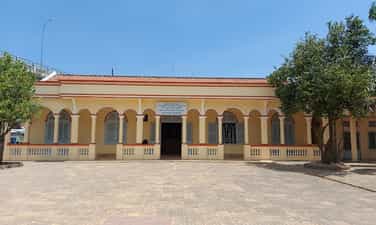
Phung Hiep town, Can Tho province is the place chosen to host the headquarters of the Southern Joint Armistice Committee, with an important strategic position, this is the center of two gathering points of Can Tho and Ca Mau. The headquarters of the Southern Joint Armistice Committee was originally the house of Mr. Ha Van Phu (owner of a Vietnamese photography shop, in Phung Hiep market), built in 1928. The entire relic site was built on an area of 1,635 m2. Looking from the outside, in front of the headquarters' door, there is a large sign, written in both French and Vietnamese - Headquarters of the Southern Joint Armistice Committee. In front of the headquarters there are 2 flagpoles. A flagpole hangs a red flag with a yellow star - Vietnam's National Flag. The second column hangs the Tam Tai flag - the national flag of France. Under the tail of the Tam Tai flag, there is also the Ba Que flag of the puppet government, proving the humiliating dependence of the Saigon puppet government. On the left side of the headquarters is a semi-permanent stilt house built in a U-shaped style, the home of the Vietnamese delegation's security force. On the riverbank in front of the stilt house is a wooden wharf for our delegation's Hoa Binh ship to dock. Every time the Hoa Binh ship has a white dove symbol on both sides of the ship, and on the roof of the ship is a red flag with a yellow star fluttering, carrying our delegation from the base in Hang Diep to the meeting headquarters, the people Both sides of the river and Phung Hiep market happily welcomed, clapped loudly... cheered our delegation every day. Successfully ending the resistance war against the French colonial invaders, with the Dien Bien Phu victory "resplendent on five continents, shaking the earth", forcing the French colonialists to sign the Geneva Agreement on Armistice in the East Positive. The Geneva Agreement signed on July 20, 1954, includes 6 chapters and 47 articles. The important content is that France recognizes Vietnam's independence, taking the 17th parallel (Ben Hai River) as a temporary military boundary. The Vietnamese People's Army in the South gathered to the North. The French colonial army had to move to the South. The North of our country has been completely liberated and built socialism. After two years, the two regions will hold general elections to unify the country. To monitor and manage the implementation of the Armistice Agreement between the two sides, according to chapter 6 of the Agreement (from Article 28 to Article 47), it stipulates the organization and operation of the Joint Committee and the National Supervisory Committee. economy in Vietnam. From the above spirit, after the Geneva Agreement was signed, the Central Joint Armistice Committee was established with Major General Van Tien Dung as its head. At the Trung Gia Military Conference, the Central Committee decided to establish the Southern Armistice Joint Committee, signed by General Vo Nguyen Giap - Commander-in-Chief of the Vietnam People's Army on July 22, 1954, for the Joint Committee to In case of armistice, direct and monitor the implementation of the Agreement and arrange troops to mobilize and assemble on time. The French delegation was headed by Colonel Duque (later changed to Colonel Colelen Bazien), the Deputy was Lieutenant Colonel Magron. There were also a number of puppet lieutenant colonels working as translators and a French female secretary. Each side's delegation has about 5 permanent members including: Head, deputy delegation, secretary, interpreter... throughout the working time of the Southern Joint Armistice Committee, protected and guarded by the People's Army. Vietnam and the French Union Army. The historical relic of the Southern Joint Armistice Committee in Phung Hiep - Can Tho has important significance in educating revolutionary traditions and building confidence in the victory of the cause of building and defending the Fatherland. From the above meaning, the Ministry of Culture and Information recognized the headquarters of the Southern Joint Armistice Committee in Phung Hiep as a national historical relic on June 28, 1996. Source: Hau Giang province electronic information portal
Can Tho
5298 view
Rating : National monument

Relics of Vi Thanh - Hoa Luu dense area
Historical - cultural relic Vi Thanh - Hoa Luu dense area is located in area 4 (Sen Lake cultural area), ward 1, Vi Thanh city, central Hau Giang province. Before the ink was dry on the Geneva Agreement signed on July 20, 1954, My Diem blatantly sabotaged it. They carried out a plot to gather people to set up a dense area of Vi Thanh - Hoa Luu, occupy Long My - Vi Thanh as a base to attack and pacify the U Minh base area, which the enemy called: "Communist headquarters." ”. To carry out the above plot, My Diem gathered evil henchmen, surrendered to traitorous hatred of the revolution and mobilized thousands of troops to launch many raids, raids, evictions, gathering people, besides Then Diem issued Law 10-59, with the motto "it is better to kill by mistake than to miss", dragging the guillotine to Long My to kill our people. It was Tran Le Xuan (Ngo Dinh Nhu's wife) who personally came here to encourage the henchmen to brutally kill those suspected of being "Viet Cong" and offered to buy a human secret from 500 to 700 VND. .The resentment is sky-high, blood flows like a river. According to the design project, the dense area is 7km long, with the Xa No canal as the center, each side is 2km wide, with a total area of 28 square kilometers, divided into 4 main areas: 1 Vi Thanh Area, 2 Fire Areas. Pomegranate, 3 Middle Areas, 4 North Xa No Areas. Each area is divided into 4 sub-areas, each sub-area is divided into many lots, each lot is divided into many plots, each plot is divided into many small plots of land, each plot is 90 meters long, 45 meters wide (area equal to 4 square meters of land) for Each family is separated by a ditch. The plots are separated by a canal 3 to 4 meters wide and 2 meters deep, in addition to being surrounded by fences and barbed wire. People living in dense areas are monitored and controlled at 5 stages: entry, travel, accommodation, income, and communication. To protect the safety of the Tru Mat Area, they arranged forces as follows: a commando company from the U-Minh area stationed at the Cai Nhum market bridge, a civil guard company guarded the outside, inside they equipped clusters of Republican youth, coordinating with the secret service to search around the clock; In addition, they also organized the personalist Can Lao Party, Republican Youth, and Women's Solidarity. People's lives were strictly controlled, so people often sarcastically called the "honey" area. Living in a situation of "fish in pots and birds in cages", the people were very dissatisfied and increasingly resentful. Under the leadership of the revolutionary Party cells, they organized many uprisings against My Diem, gathering people to set up a Secret Zone. Faced with that difficult and complicated situation, after only six months of intense construction, although only a third of the project was built, on March 12, 1960, they hastily organized the inauguration of the Vi Thanh - Hoa Secretariat. Pomegranate. Resolution 15 of the Party Central Committee was born like "drought meets rain", a strong driving force pushing the struggle movement in the district to become even more fierce. On the night of September 14, 1960, the Dong Khoi order was issued, our armed forces raided and occupied many places. Coordinating with the people and patriotic soldiers in the dense areas and 12 gathering points, they rose up together to hunt down the evil henchmen and hand them over to the revolution, burned the flag, tore up Diem's photo, took down slogans, and destroyed Fence, break the gate to return to the old hamlet. Cheers, gongs, and gunshots resounded, creating a revolutionary atmosphere, a strength that "made the water burst its banks". In addition to attacking, the uprising completely paralyzed the enemy in the dense areas. To deepen the crime and educate our people, especially the younger generation, about hatred for America - The puppet established Vi Thanh - Hoa Luu Secret Zone, on August 2, 1997, the Ministry of Culture and Information recognized " "Vi Thanh - Hoa Luu Secret Site, relic of My Diem's massacre of compatriots" is a national historical-cultural relic. Source: Department of Culture, Sports and Tourism of Hau Giang province
Can Tho
5502 view
Rating : National monument

Can Tho Provincial Party Committee Base Relic Area
Can Tho Provincial Party Committee Base Relic is located in Phuong Quoi B hamlet, Phuong Binh commune, Phung Hiep district, Hau Giang province. During the resistance war against the American invasion, Can Tho city was the nerve center of the 4th tactical zone of the American puppet, the US consulate, the C-I-A intelligence agency, all types of soldiers, rear warehouses, and military yards. airports, military ports, etc. were the places where troops raided the southwestern provinces. The enemy chose Can Tho as the key area for pacification and fierce raiding, especially after the general attack in 1968. In the years 1969 - 1970 - 1971, they mobilized a large force of main forces, security forces, civil guards and various types of machines. Planes, tanks, cannons... dropped bombs, artillery, B52s spread carpets, toxic chemicals, cleared our liberated countryside, coupled with tactics to lure people in, trying to separate the people from the Party "slapping water to catch fish". ", aiming to destroy the Party and the revolution. To deal with the enemy's new plot, in April 1971, the Executive Committee of the Can Tho Provincial Party Committee met in the leafy forest of Xa Phien commune, Long My district. After careful discussion, the Standing Committee of the Provincial Party Committee chose the location in Phuong Quoi B hamlet, Phuong Binh commune, Phung Hiep district, as a base for the Provincial Party Committee to stand and direct the revolutionary movement in the province to attack. Failure of the enemy's pacification plot. Can Tho Provincial Party Committee Base was started construction in early February 1972, at the house of Ba Bai - a former landowner, so people used to call it "Ba Bai Base". Initially, the base only built a few small houses, the workplaces of the Standing Committee, Office and defense team (security team). After that, build a number of other houses for the following departments: cipher, radio, information, housing for female officials, permanent house, guest house, canteen, and communications. From this base, the Can Tho Provincial Party Committee stood firmly and led the province's army and people to attack the enemy with three frontal attacks, remove enemy posts, mobilize the masses to destroy "strategic hamlets", and gain the right to open the land. Expanding the liberated area, creating new strength for the province. The Paris Agreement was signed and took effect on January 28, 1973, but the enemy, with their stubborn nature, sabotaged the Agreement and carried out plots to "pacify", "overrun the territory", and occupy land and people. . But the Can Tho Provincial Party Committee still firmly stood firm at its base, leading the province's army and people to overcome all difficulties, hardships and sacrifices, promoting the power of three prongs to attack the enemy, breaking up many raids and encroachments. , remove the enemy's posts, and reclaim our liberated area. Promoting victory, and at the same time strictly complying with the orders of the Central Party Politburo, launched a general attack and uprising in the spring of 1975, culminating in the historic Ho Chi Minh campaign, completely liberating the South, carrying out the sacred Will of our beloved Uncle Ho: "Fight until the Americans go away, fight until the puppets fall". Under the wise, flexible and bold leadership of the Provincial Party Committee, Can Tho's army and people launched a general attack and uprising like a storm, "One day equals twenty years". In just two days, April 30 and May 1, 1975, Can Tho province was completely liberated, contributing to the liberation of the South, writing the most brilliant pages of history of the Vietnamese people in the 20th century. With those important historical events and achievements, on April 27, 1990, the Ministry of Culture and Information issued a Decision recognizing the Can Tho Provincial Party Committee base as a national historical-cultural relic. Source: Hau Giang province electronic information portal
Can Tho
5759 view
Rating : National monument

Tam Vu Victory Relic
Tam Vu Victory Relic Area is located in Xeo Cao hamlet, Thanh Xuan commune, Chau Thanh A district, Hau Giang province. The glorious victories of the four ancient Tam Vu battles that took place on the Cai Tac - Rach Goi road section, less than 5km, were a brilliant highlight in the resistance war against the French colonial invaders of our army and people. After September 23, 1945, the Saigon - Gia Dinh army opened fire against the invading French colonialists, opening the Southern resistance war, then on October 30, 1945, the Can Tho army and people became heroic in their resistance against the French colonialists. recaptured Can Tho. After 90 days of siege and attrition, destroying the French army in Can Tho town, Le Binh's suicide squad disguised itself and gathered at the French command post in Cai Rang on the morning of November 12, 1945. Wounding many enemy soldiers, including the wounded officer of Rouen, terrified the French soldiers. With courage, the Republican Guard unit commanded by comrade Nguyen Dang on January 20, 1946, attacked the enemy's military convoy on Tam Vu Highway, destroyed 2 military vehicles, and killed a number of enemy soldiers. including Dessert, commander of the French expeditionary force in the West, one of five high-ranking French officers on the Indochina battlefield. We confiscated 10 guns, including 2 medium machine guns. The Battle of Tam Vu 1 had a very important meaning, this was the first victory of our armed unit against enemy motor vehicles, opening the door for the next battles on the Can Tho battlefield. Less than a year later, Can Tho's army and people continued to win the battle of Tam Vu 2, on November 12, 1946, commanded by comrade Ngo Hong Gioi, ambushing the enemy's military convoy on Tam Vu Highway. , destroyed 3 vehicles, killed 60 French and Le Duong soldiers, collected 60 guns of all kinds and many other military equipment and supplies. After the day of "National Resistance", implementing the directive "All People's Resistance" of the Party Central Committee's Standing Committee (December 19, 1946) and the call of beloved Uncle Ho (December 20, 1946). The all-people and comprehensive resistance war has developed strongly, Can Tho's army and people have achieved many victories, especially the activities of the "Party Assassin" teams, Rangers, and armed police to destroy enemies and evildoers. The storm in the inner city of Can Tho made people confused and afraid. At this time, the Tam Vu 3 battle took place on May 3, 1947, commanded by Minister Huynh Phan Ho, also on the old Tam Vu route. Our army and people destroyed 6 military vehicles, killed and injured nearly 200 French soldiers, and captured 8 machine guns, many guns and ammunition of all kinds, as well as military equipment and supplies. The Battle of Tam Vu 3 was a victory of heaven, earth, and people. When we returned to camp at Lang Ham to prepare for the Battle of Tam Vu 3, a squad of Khmer soldiers came in to cut down trees and were forced to destroy them. Our troops withdrew as a diversion, only 10 days later they returned to hide their troops, continuing to fight the Tam Vu 3 battle without being exposed, because the people protected the soldiers to defeat the enemy. Victory after victory, just one year later, the beautiful coordination of three types of troops (main force, local army and guerrilla militia) created a heroic miracle, continuing to win the battle of Tam Vu. 4, took place on the afternoon of April 19, 1948, under the command of Minister Tran Van Giau and Chief of Staff Vo Quang Anh, our army used the tactic of occupying and attacking, destroying 14 enemy military vehicles, killing Nearly 200 French soldiers, including one Quang Ba, collected many guns and ammunition, especially the 105mm cannon for the first time in the country, resounding throughout the Indochina battlefield. With the profound meaning and scale of victory of the 4 Tam Vu battles, the golden book of our nation's revolutionary tradition against invaders has become even more brilliant. Therefore, the Ministry of Culture and Information recognized the Tam Vu victory site as a national historical-cultural relic on January 25, 1991. Source: Hau Giang Province Electronic Information Portal
Can Tho
8602 view
Rating : National monument
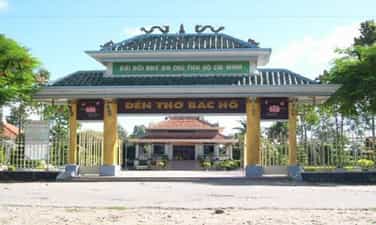
Uncle Ho's Temple in Luong Tam Commune
Uncle Ho's Temple relic is located in hamlet 3, Luong Tam commune, Long My district, Hau Giang province. The people of the South in general, the people of Hau Giang - Can Tho and Long My in particular, the image of beloved Uncle Ho is in the hearts and minds of every person, although thousands of kilometers away from the capital Hanoi, always look towards Uncle Ho and his beloved capital with firm belief to fight and defeat the invading enemy. Hearing the news of Uncle Ho's death on September 2, 1969 was a common pain and a great loss for the entire Vietnamese people; Especially the people of the South have not had time to welcome Uncle Ho to visit. To repay Uncle Ho's kindness and meet the wishes of the people of Luong Tam commune; The Commune Party Committee, led by comrade Lu Minh Chanh (Hai Chanh), Secretary of the Commune Party Committee, decided to set up an altar to Uncle Ho right at the Commune Party Committee Office. Comrade Le Van Thong, member of the secretary, was assigned the task of releasing photos of Uncle Ho setting up an altar and sewing funeral ribbons to organize the memorial service. The next day, the memorial service was solemnly held with the full presence of leaders of departments, branches, organizations of communes, hamlets, main army units, and local soldiers stationed near the base. Commune officials, along with a large number of people in the commune, came to attend the ceremony with infinite sadness, commemorating and remembering Uncle Ho's gratitude to heaven and earth and promising Uncle Ho the determination to defeat the American invaders. Responding to the call of the Party Central Committee - turning suffering into revolutionary action, Can Tho's army and people continuously attacked the enemy in all areas of the province. During the week of Uncle Ho's mourning, the army and people of Can Tho province launched an attack on 34 military targets, destroying nearly 400 enemies. In Luong Tam commune alone, our army and people destroyed the posts: Vam Cam, To Ma, and Duong Dao (severely damaged). Over 40 enemy soldiers paid for their crimes and many others were injured. Right after the National Funeral Day, the leaders and some veteran revolutionary comrades and elders in the commune discussed and came to a decision: to build a temple to Uncle Ho in Hamlet 3, at the intersection of the highway. This is the most convenient place for people in the commune and other areas to easily visit Uncle Ho by both waterway and road. In the summer of 1972, the US puppet launched many large-scale raids, concentrating bombs and artillery on fiercely attacking the Long My area. The Commune Party Committee was destroyed by American artillery bombs and had to be moved to another place. Uncle Ho's altar was rebuilt and the holidays to celebrate Uncle Ho were held every year (birthday, death anniversary and Lunar New Year). In addition, people in the area worship Uncle Ho and celebrate his death anniversary at home. After the day of peace, from the earnest wishes of the Party Committee and people of Luong Tam commune, they wished to rebuild Uncle Ho's Temple at the planned location during the resistance war against the US, at the intersection of the highway, hamlet. 3, Luong Tam commune and with the approval of the leaders, branches, levels and people inside and outside the locality actively contributed their human and material resources, with a heart of love for Uncle Ho and this is a practical memorial project to welcome Uncle Ho. Celebrate the 100th anniversary of Uncle Ho's birth. (May 19, 1890 - May 19, 1990). Uncle Ho's temple was built in 1990, with a scale of nearly 2 hectares. Uncle Ho's temple was built with a national, solemn and respectful architectural style. On the occasion of the 107th anniversary of Uncle Ho's birth (May 19, 1890 - May 19, 1997), provincial leaders continue to direct the construction of an exhibition house to introduce Uncle Ho's childhood and revolutionary life. Uncle, this is the second category after the Temple. With that meaning, the Ministry of Culture and Information recognized Uncle Ho's Temple as a National historical relic. Source: Long My District Electronic Information Page
Can Tho
5781 view
Rating : National monument