Relic point Vietnam
Việt Nam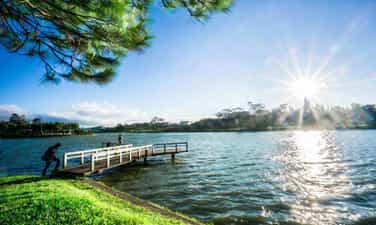
Xuan Huong Lake Relics
When mentioning Da Lat, no one knows about Xuan Huong Lake, a beautiful lake located right in the center of Da Lat city. Xuan Huong Lake is an artificial lake, with a circumference of about 5km and 25ha wide. The lake has the shape of a crescent moon, stretching more than 2 km and passing through many famous tourist attractions of Da Lat such as the City Flower Garden, Yersin Park, Cu Hill and Lam Vien Square. According to people here, the origin of the name Ho Xuan Huong comes from two different legends. The first legend says that every spring, there is a faint, fragrant scent around the lake, ecstatic. That's why people gave the lake the name Xuan Huong Lake. However, the second legend says that Ho Xuan Huong was named after a 19th century Vietnamese female poet named Ho Xuan Huong. Ho Xuan Huong is the author of a number of famous poems such as Floating Water Cake, Life as a Monk, Debt to Husband and Children,... Xuan Huong Lake was originally a large valley, and Cam Ly stream flowed through. In 1919, engineer Labbe blocked this stream so that water could accumulate and form a lake. Then, in 1923, French engineers built a dam at the bottom of the lake, but it broke after a storm in 1932. Engineer Tran Dang Khoa then rebuilt a new dam. made of stone. In 1989, Xuan Huong Lake was recognized by our state as one of the famous landscapes and historical relics in Da Lat, ranked as a national monument. Source: Da Lat tourism information portal
Lam Dong
5749 view
Rating : National monument

Tuyen Lam Lake Relic in Da Lat
Tuyen Lam Lake was formed in 1985 - 1986. At that time, the People's Committee of Lam Dong province and Duc Trong district deployed troops to build dams to retain water in the Suoi Tia area. Surrounding the Suoi Tia flow area are surrounding mountain ranges that form a basin. When the dam is built to retain the water, it forms Tuyen Lam Lake as it is today. Initially, the main purpose of Tuyen Lam Lake was to store water for main use for irrigation in agricultural production in the downstream area - Hiep An and Dinh An communes in Duc Trong district of Lam Dong province. By 1998, when Tuyen Lam Lake was recognized by the Ministry of Culture, Sports and Tourism as a national historical and scenic site on August 31, 1998, the Tuyen Lam Lake area received even more attention and attention. Not only does it serve irrigation purposes in agricultural production, but it is also used by agencies from central to local levels to guide tourism development planning. Tuyen Lam Lake has an area of 350 hectares; More than 6km south of Da Lat city center. Tuyen Lam Lake area has a fresh climate, quiet space, natural landscapes (forests, mountains, lakes, streams, waterfalls,...) that are diverse, attractive and have many attractive and promising humanistic elements. become a large-scale tourist area with many unique types of tourism such as: sightseeing, camping, relaxation, medical treatment, walking, climbing, fishing, festivals - beliefs, entertainment entertainment, sports,...especially eco-tourism. During the two resistance wars against the French and American invaders, with the location and topography of the Suoi Tia area (now Tuyen Lam Lake) and Elephant Mountain, it was the most important base of the revolutionary movement in Da Lat city and Da Lat city. Tuyen Duc province. This base area serves as a place to direct political and armed struggle movements of the army and people of Da Lat town and Tuyen Duc province, and a place to gather and train the armed forces. , the working teams of the Province and the military region, are the springboard for forces to attack Da Lat and maneuver to fight the enemy on fronts in Tuyen Duc province. During the resistance war against the Americans, in addition to the City Party Committee, there were also military units stationed such as the Financial Department, the clinic, the Women's Work Team, the Youth and Students, the Urban Work Team, and the City Special Forces 850 and 852. , 860... and leading agencies and front units of the province such as the Provincial Party Committee, Provincial Team, logistics, Corridor Station, Company 810 (later to become Battalion 810), Provincial Security Team and forces of the Region 6 as Battalions 186, 145, 200C. From 1982 to 1987, Lam Dong Irrigation Company, invested by the Ministry of Irrigation, built a 235m long dam across Tia stream to create Quang Trung lake, later renamed Tuyen Lam lake. By 2017, the Prime Minister recognized Tuyen Lam Lake National Tourist Area, Da Lat City, Lam Dong Province as a National Tourist Area. Tuyen Lam Lake National Tourist Area was honored by UNESCO as "Typical Asia-Pacific Tourist Area" in the Forum Program "Vietnam - India Cultural and Economic Exchange". Tuyen Lam Lake National Tourist Area has rich tourism resources including natural landscapes, forest resources, climate, cultural and architectural values; Invested and renovated infrastructure along with ongoing investment projects have been promoting value, contributing to affirming the position of Tuyen Lam Lake National Tourist Area on Vietnam's tourism map. South with diverse types of tourism. Source: Management Board of Tuyen Lam Lake National Tourist Area
Lam Dong
5312 view
Rating : National monument
Historical site in Da Lat - Than Tho Lake
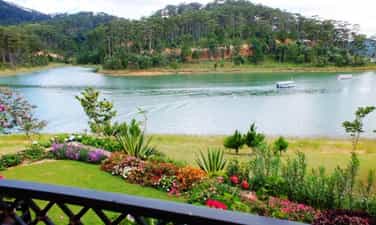
Than Tho Lake is located about 6 km east of Da Lat city center, near Da Lat National Martial Arts School (currently the Army Academy). The lake is located on a high hill in the middle of a pine forest, providing a peaceful and quiet space. On the north side of the lake there is a pair of pine trees that evoke the image of a couple, near the scenic Pine Hill Two Tombs with the legend of a broken love. Initially, the Than Tho lake area was just a small pond, and was called Tono Pang Dong. However, in 1917, the French built a lake here to provide daily water for Da Lat. The French named the lake Lac Des Soupirs (meaning "murmuring lake" in French). However, later, the lake was renamed Than Tho Lake by Mr. Nguyen Vy, Chairman of Da Lat Town Council, to express sympathy for the legend of the romantic love story between Hoang Tung and Mai relying on the year of the 18th century here. Than Tho Lake has experienced many ups and downs in history. From the reclamation of mountains and forests in the 1980s - 1990s, to the process of conservation and restoration at the end of 1990. In 1999, Than Tho Lake was recognized and ranked by our state as a scenic spot, national historical relics. Source: Da Lat tourism information portal
Lam Dong
5132 view
Rating : National monument
Da Lat Pedagogical College
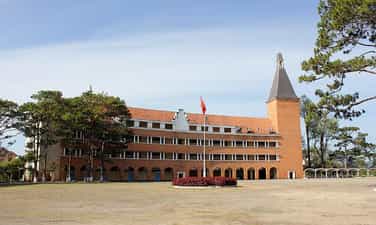
Da Lat Pedagogical College was established on September 3, 1976 by decision of the Ministry of Education. The school was assigned by the Ministry of Education to become a secondary school teacher training center for Lam Dong province as well as some neighboring provinces. Initially, the school was called Grand Lycée Yersin, built by the French in 1927 for French citizens and some wealthy families to study. The school's main building is designed and built in a unique style and has been recognized by the World Association of Architects. After the victory of the Ho Chi Minh campaign on April 30, 1975, the school was reclaimed by the Vietnamese government and converted into Da Lat Pedagogical College. Currently, the school's buildings have been repaired and upgraded, with new roofing tiles being replaced. The school's special features lie in its 54-meter high bell tower and unique arc-shaped buildings. In 2001, Da Lat Pedagogical College was recognized by our state as one of the historical relics in Da Lat recognized as a national relic. In August 2022, Da Lat Pedagogical College was merged with Lam Dong Economic and Technical College and Da Lat Vocational College, then renamed Da Lat College according to the decision of the Ministry of Labor Movement, War Invalids and Society. Source: Da Lat tourism information portal
Lam Dong
4813 view
Rating : National monument

Dalat Railway Station
Da Lat Station is not only a unique architectural work of Da Lat city, but also a place that makes a special mark in the history of Vietnam Railways. Da Lat Station is located on Quang Trung Street (Ward 10, Da Lat City, Lam Dong Province), also the only train station in the Central Highlands region. Da Lat Station is associated with the history of formation and development of the "land of thousands of pines" urban area, considered the most beautiful ancient train station in Vietnam and Indochina. Da Lat Station was built from 1932 to 1938, located on the Thap Cham - Da Lat railway, connecting the plateau city with Phan Rang (Ninh Thuan). This railway line is 84km long, with an elevation difference of 1,500m, and was started in 1908 by order of Governor General of Indochina Paul Doumer. In 1932, the route was completed, which was also the time to build Da Lat station. The entire route has 12 stations and 5 underground tunnels. It is a special railway because it has 16km of cog railway climbing steeply, with an average slope of 12%. At that time, railways and locomotives with cog wheels only existed in Switzerland and Vietnam. In 1972, this railway line was destroyed by war. In 1975, the country was unified, this line was restored but only operated for a short time due to poor economic efficiency. The rail system and cog railway tracks were removed. The stations were abandoned. Dalat Railway Station was designed by two French architects, Moncet and Revéron, with bold indigenous architecture. The structure of the project is coherent and scientific, but the form is very sophisticated. The building has a symmetrical layout, with the architectural block in the middle simulating the three peaks of Langbiang Mountain and the roofs of the Central Highlands' communal houses; On both sides are two sprawling architectural blocks. In the middle of the building, outside, under the roof, there is a large clock face recording the time Dr. Alexan Dray Yersin discovered Da Lat. In the middle block, there are two front halls, one for passengers and one for cargo. Between these two paths is the train waiting area. This middle architectural block has only 1 floor with large space and a height up to the roof. Overall, the building's architecture is in harmony with nature and is a unique urban highlight. Da Lat Station was recognized as a national historical and cultural relic in 2001. Currently, Da Lat station has been separated from the Vietnam national railway system, but is still an attractive tourist destination. The station maintains a tourist train consisting of 1 locomotive and 4 carriages going back and forth to Trai Mat station (ward 11, Da Lat city), located in the east, 7km from Da Lat, about 25 minutes away. On this road, visitors can admire the romantic suburban landscape of the city. At the last stop is Trai Mat station, visitors can visit Linh Phuoc Pagoda (also known as Ve Chai Pagoda) - a famous and unique pagoda. In addition, Da Lat station still sells intermodal tickets on the Thong Nhat railway, departing from Nha Trang station (Khanh Hoa) and serving Da Lat - Nha Trang transit cars. Along with famous works of Da Lat such as: Cathedral, Bao Dai Palace, Da Lat Pedagogical College..., Da Lat Station is a destination not to be missed for tourists coming to the city. Da Lat. There is also an antique steam locomotive on display and a cafe located in a train car. The station's romantic scenery and ancient architecture is a place where many people come to "hunt" for beautiful photos Source: Vietnam National Tourism Administration
Lam Dong
5731 view
Rating : National monument
An Dinh Palace
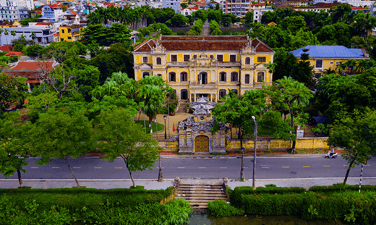
An Dinh is the private palace of King Khai Dinh, located on the bank of An Cuu River, formerly in De Bat Ward - Hue Town, now 97 Phan Dinh Phung Street, Hue City. Originally at this location since Thanh Thai 14 (1902), Phung Hoa Cong Nguyen Phuc Buu Dao (later known as King Khai Dinh) established a palace, naming it An Dinh palace. In the year Khai Dinh 2 (1917), the king used his own money to renovate the palace according to modern architectural style. In early 1919, construction work was completed, the palace still retained its name. From February 28, 1922, An Dinh Palace became the potential residence of Crown Prince Vinh Thuy (later King Bao Dai). After the August Revolution of 1945, former Emperor Bao Dai's family moved from the Royal Palace to live at An Dinh Palace. After 1954, the Ngo Dinh Diem government confiscated the An Dinh Palace. After 1975, Ms. Tu Cung donated An Dinh Palace to the revolutionary government. Up to now, An Dinh Palace relics are being restored. An Dinh Palace faces south, towards An Cuu River. The palace has a flat terrain, total area of 23,463m2, surrounded by a brick wall, 0.5m thick, 1.8m high, surrounded by an iron fence. When intact, the palace had about 10 structures. From front to back are: Boat wharf, Main gate, Trung Lap communal house, Khai Tuong pavilion, Cuu Tu Dai theater, animal cage, lake... through time and the devastation of war, up to now the palace only The remaining 3 works are quite intact: the main gate, Trung Lap communal house and Khai Tuong pavilion. The main gate is made of three-door style, two floors, decorated with elaborately embossed porcelain. Trung Lap Communal House, located inside the door, has an octagonal structure with a high foundation. In the communal house, there is a bronze statue of King Khai Dinh, life-sized, cast in 1920. Khai Tuong Pavilion is located behind Trung Lap communal house, which is the main architectural work of An Dinh Palace. The word Khai Tuong (meaning the place where good omens originate), the floor's name was given by King Khai Dinh. The 3-storey floor, built with new materials in the style of a European castle, occupies an area of up to 745m2. The floor is very elaborately decorated, especially the interior of the first floor with murals of very high artistic value. Along with other architectural works of the Khai Dinh period such as Khai Dinh mausoleum, Kien Trung floor, Hien Nhon gate... An Dinh palace is considered a typical representative of Vietnamese architectural style in the neo-classical period. Neo - Classique. The work was recognized as a national monument on December 13, 2006. Source: Thua Thien Hue electronic information portal
Hue
4989 view
Rating : National monument

Thai Binh communal house
Thai Binh Communal House is one of the ancient communal houses with a harmonious decorative architecture that preserves traditional national art and is modern, located in Quarter 4, Ward 1, Tay Ninh City, Province. Tay Ninh. Thai Binh Communal House was built over 100 years ago to worship the God Hoang Bon Canh Vo Van Oai - a mandarin of the Hue court who fought against invaders from across the border and martyred himself in this area. On March 18, 1917, King Khai Dinh, in his second year, ordained Thai Binh communal house. The communal house was majorly repaired in 1950. The communal house's grounds are 1,700 square meters wide, the vestibule faces Southeast, the facade is embossed with scroll symbols: books and swords, on both sides there are bell towers, drum towers, and the top of the communal house's roof. There are two dragons flanking the moon. The interior is decorated with diaphragms: "Peaceful scene" and "Divine inspiration". Along with pairs of gypsies, phoenixes, pine trees, chrysanthemums, bamboo, apricot blossoms and worshiping objects. On December 12, 1994, Thai Binh Communal House was ranked by the Ministry of Culture and Information as a national historical-cultural relic and was restored and renovated in 2013. The annual Ky Yen Festival is held on the 15th and 16th of the 11th month (lunar calendar), with an ordaining procession, opera singing, martial arts demonstrations and other folk cultural activities. Source: Provincial Department of Culture, Sports and Tourism
Tay Ninh
5553 view
Rating : National monument

Hiep Ninh Communal House
Dinh Hiep Ninh is located in Quarter 4, April 30 Street, Ward 3, Tay Ninh and only about 4km from the city center. The people of Tay Thanh are always proud of a long-standing architecture that has been built for more than 100 years, not only with impressive sculpture but also associated with glorious historical periods of the Vietnamese people. Hiep Ninh Communal House worships the village's Thanh Hoang Tran Van Thien - the person who immigrated, reclaimed land and established hamlets, preserved land and protected the border. At the Tay Ninh Museum today, King Khai Dinh's decree made of precious silk fabric, embroidered with pearls and brocade, is still preserved on March 18, 1917. According to folk beliefs, village communal houses are places that clearly demonstrate the values of cultural life. For Southern people in general (Tay Ninh in particular), the village Thanh Hoang is a deity who always protects and protects all villagers to have a good, fulfilling and happy life. The majesty of the communal house, in addition to its religious roots, is also the crystallization of the "sacred soul of rivers and mountains", built over many generations, with blood and sweat to explore and protect village land. With that meaning, the historical relic of Hiep Ninh communal house is not only a sophisticated architectural work but also shows the gratitude of Tay Ninh people to the village's Thanh Hoang. Hiep Ninh communal house Tay Ninh is one of the ancient communal houses with extremely unique architecture that still exists today with a curved roof, covered with new, even, red and bright tiles. This place also preserves the massive features of dense, sophisticated and highly valuable sculptural decorative motifs. Up to now, there are no documents or historical books that accurately confirm the date, month, or year of establishment of the ancient communal house. In the book Tay Ninh historical relics and scenic spots of the Provincial Museum (2001), it is written that the communal house's construction time was "around 1880", but did not cite the exact source. In 2021, the Tay Ninh Provincial Museum made a report on "Results of the inventory of Han Nom writing materials" which also mentioned the information: "Hiep Ninh Communal House was established during the land opening period, around the mid-19th century…” Going back in time, the ancient communal house has quite simple architecture, built of rattan, bamboo and cork. However, at the Tay Ninh Museum, there is still a panoramic photo of Hiep Ninh communal house which was renovated and renovated for the first time in 1901 and the second time in 1910. Compared to the current ancient communal house, the following appearance When renovating for the first time there is not too much difference. This gives us a rather interesting historical inference, that is, the ancient communal house was certainly solidly built before the renovation in 1901, partly verifying the authenticity of the information about the ancient communal house's construction. before the 1900s. The hundred-year-old communal house is not only a relic but also a witness to a glorious history. During the historic August Revolution general uprising in the fall of 1945, the youth vanguard force gathered here, standing side by side with the revolutionary masses to overthrow the yoke of fascist colonial rule. build a new revolutionary government. In particular, during the period of 1959 - 1960, Hiep Ninh communal house was also the base of the Tay Ninh Provincial Party Committee led by comrade Hoang Le Kha, trusted and supported by the people. Hiep Ninh communal house was recognized by the state as a Historical and Architectural - Artistic Monument on October 12, 1993. Source: Tay Ninh Tourism
Tay Ninh
5418 view
Rating : National monument

Cao Cao 601 revolutionary historical relic
17 km north of Kon Tum town along Highway 14, there is a place that many of us know, which is Doc Dau Skull. Skull Slope is a new folk name that came into existence after the war in April 1972 between the revolutionary army and the enemy. The Ba Na people in this area call that place Kon Loong Pha, which means a slope with many Trac trees and High Point 601 is a military term for the enemy's military base on K-Rang Loong Pha hill. Until early 1972, the high point was still an important military point of the enemy, including artillery and tank positions arranged on two saddle-shaped hills. In the north, there is Ha Mon Security Station, guarded by the 23rd Security Battalion, with reinforced armored vehicles. In the south, there is the 3rd Airborne Brigade Headquarters, a large artillery field, tanks, and armored vehicles. There are also enemy artillery positions and Security posts in Kon Trang K-la; Ironing yard; North of Kon Tum town... With an important military strategic position, capturing high point 601 means controlling most of Kon Tum town as well as the entire Dak To - Tan Canh region. Capturing High Point 601 means completely mastering strategic road 14, the northern section of the Central Highlands. Realizing the importance of High Point 601, we were determined to capture it, and on the enemy side, they also tried to defend themselves by all means. On April 10 and 11, 1972, with the spirit of determination to fight and determination to win, we won a big victory at High Point 601. Results obtained: Destroyed 2 enemy armored squads, a convoy of goods, destroyed Destroyed 28 vehicles (including 14 tanks, M113 armored vehicles and 14 transport vehicles), destroyed 72 tons of military equipment and supplies, destroyed a security platoon, severely damaged 2 parachute companies, suffered heavy losses. Damaged the headquarters of the 23rd Airborne Brigade, a mortar battlefield, destroyed hundreds of enemies, shot down 2 planes, destroyed 2 106.7 mm mortars, captured more than 15 guns of all kinds, we cut off completely route 14. Together with local soldiers and guerrilla militia, this was a highly effective traffic cutting battle of the 28th Regiment in the Spring - Summer 1972 campaign in the Central Highlands. Since the signing of the Paris Agreement (from early 1973 to 1975), the area of High Point 601, KRang Loong Pha Slope (Skull Slope) and the entire Dak La and Ha Mon area have been disputed areas between us and the enemy. . Many fierce political struggles took place here, sometimes even using military weapons to win every inch of land with the enemy: With the correct policies of the superiors combined with intelligence, strategy and the heart Through the courage of our army and people, despite many hardships and sacrifices, we were able to maintain the entire liberated area of Dak To - Tan Canh to Dien Binh and Ha Mon and control the Dak La area, contributing to liberated Kon Tum town in the spring of 1975. Over the past years, Kon Tum General Museum has listed relics throughout the province, of which High Point 601 is a revolutionary historical relic that is of great interest to provincial leaders as well as the Culture sector. Recently, the Provincial Museum has compiled a scientific profile for the High Score 601 historical site to request a ranking. Although late, this is a truly meaningful work. More than 30 years after the victory of High Point 601, due to human impact and the harsh natural environment, the relic is only a vestige, but it is still convincing. Revolutionary historical relic High point 601 was ranked as a provincial-level relic by the Provincial People's Committee on May 17, 2003. Source: Dak Ha district information portal
Quang Ngai
5716 view
Rating : Provincial level relics

Thien Hau Temple (upper temple)
Thien Hau Temple (Thien Hau Upper Street) is located on Trung Trac Street - Quang Trung Ward - Hung Yen Town. The temple was built in 1640 by 14 Chinese families in Guangdong, Guangxi and Fujian donating money to build it. Thien Hau Temple worships Mrs. Lam Tuc Mac, according to "Dai Nam Nhat Thong Chi", she is a sea god. Lam Tuc Mac was born on March 23 (lunar calendar) as the 6th daughter of Lam Nguyen, from Bo Dien, Fujian province (China). Legend has it that when Lam Tuc Mac was born, he had a sweet fragrance and a brilliant aura. Lam Tuc Mac is very smart. When he was 8 years old, he went to study immortality, trained to become righteous, could call rain and wind, and use magic to ride a flying mat on the sea. When the people had poor harvests and famine, she found seaweed to eat instead of rice, noodles, and barley, so the people were no longer hungry. She found a type of magnolia oil and sprayed it on the ground to grow plants to grow seeds to eat instead of rice... On the 9th day of the 9th lunar month, she was no longer sick but cured. After transforming, she often wore a red shirt and flew over the sea to help passing boats. Fujian people worship her as the god of navigation. Wherever there are Fujian people, there is a temple to worship her. When migrating to Pho Hien, Fujian people built a temple to worship her on Bac Hoa street (now Trung Trac street). Thien Hau Temple is a project with bold Chinese architectural colors in many items such as: ritual gate, incense burning house, roof, corner blades and truss structure. Legend has it that the temple was built in China and then brought to Pho Hien to build it. Nghi Mon is built like a house, with a tiled roof, the architecture of the pillars, and the door system engraved with images of civil and military mandarins and their followers. The terrace is paved with pebbles that have not worn away through wind and rain for hundreds of years. In front of the ritual gate, there is a pair of goats: the male holds a jade, the female holds a baby, made of marble, very vivid artifacts. The two stone pigs represent the Chinese concept of life: having wealth and having children is the greatest happiness in life. The inner temple area is built in the style of a Dinh letter, including an incense burning house and a harem. The match-stacked incense burning house has 2 floors and 8 roofs, the roof is tiled, the roof line is decorated with Buddha sitting on a lotus, surrounded by passersby. The entire system is structured in a special form with each theme and Chinese story such as: Three Kingdoms, Journey to the West... In addition, here are also decorated with various kinds of flower strings, bowls of horses, pantyhose, and scenes. four seasons: Spring, summer, autumn, winter. The harem consists of 3 rooms, the architecture is "stacked with wings", the ends are carved into the shape of a carp. The outer harem worships Lam Tuc Mac while the inner hall worships her parents, siblings and the Chinese families who contributed to building the temple. Every year, Thien Hau Temple holds festivals on March 23 and September 9 (lunar calendar) to celebrate the birth and transformation of Lam Tuc Mac. A large number of Chinese families in Pho Hien and Vietnamese people came to worship. During the festival, a grand palanquin procession is held, offerings include seaweed cakes, turtle cakes, To Chau cakes... which are traditional Chinese products. Thien Hau Temple is one of the very few ancient Chinese architectural works in Pho Hien still preserved today. With the purpose of preserving and promoting to the masses, Hung Yen province restored Thien Hau Temple to be spacious and clean and in 1992 it was recognized by the Ministry of Culture and Sports as a historical and architectural relic. Artistic architecture. Source: Hung Yen Electronic Newspaper
Hung Yen
3886 view
Rating : National monument