Relic point Vietnam
Việt Nam
Ban Keo Hill
Ban Keo hill is located in the northwest of the stronghold group. The French colonialists gave Keo village a new name as the Anno Mari resistance center. This base is located next to Keo village - a village of Thai ethnic people, so it is called Keo hill. In Thai, Keo means a small "Thung" at the foot of the mountain. Here there is a large beach near the foot of the mountain (currently soldiers often use it as a training ground). Ban Keo hill is not very high but quite long, shaped like a crescent moon, concave and facing the northern mountains. Along with Doc Lap Hill, Keo village is responsible for protecting Muong Thanh airport, preventing attacks by our troops from the direction of Lai Chau to Dien Bien Phu. Here, the French army arranged a quite solid defensive fortification system. In addition to the fortified battlefield, they also use barbed wire fences surrounding the base. Opening the first attack, on March 13, 1954, we destroyed the Him Lam base. On March 15, 1954, we destroyed Independence base. At this time, Ban Keo base had become isolated, under strong threat from our troops, those reluctant puppet soldiers were in a very tense mood and during the 2 days of the battle, the Thai soldiers witnessed The rapid collapse of the two strongest resistance centers, protected by French European and African units considered to be fierce, saw with their own eyes how soldiers, even when going to the rescue, were beaten to pieces in their vehicles. Bloodied monks from Doc Lap fled to Muong Thanh, and now they had to consider a way out, they saw the strength of the Viet Minh. The Viet Minh had big artillery and a mighty army. The Viet Minh had artillery trucks. Just appearing on the field was a strange event never seen before in the war at Dien Bien Phu. The 36th Regiment of the 308th Infantry was assigned to destroy Keo village. The 36th Regiment realized that it had the ability to solve this stronghold without a battle, so it used a single-army order to call on the Thai soldiers to surrender. On March 16, 1954, at the foot of Ban Keo hill, a large picture-like scene appeared of a group of Thai soldiers leaving their positions with the words: "Return to the Fatherland, with your compatriots, you will received a kind welcome." Although the French commander tried to control him, the Thai soldiers took advantage of the time the French commander went underground to hide, brought out their weapons, and pulled out the line. The French sent tanks to chase the Thai Wei army and artillery. of the Viet Minh fired to cover the above-mentioned soldiers running to safe shelter positions in the forest. Without firing a shot, the 36th Regiment captured Keo village, ending the first attack, opening the northern door to the center of the Dien Bien Phu stronghold. Source: General electronic information portal of the Department of Culture, Sports and Tourism of Dien Bien province
Dien Bien
5003 view
Rating : National monument

Independence Hill
Independence Hill is a component relic of the Dien Bien Phu Battlefield Special National Monument. Doc Lap Hill has another name: Pu Vang (Victory Hill). Located right at the foot of Pu Vang is Tong Khao field, a sunken field. In the past, the Phe invaders captured all the children in the area and killed them. Children who are still infants are put in a mortar and pounded. Children who are toddlers or older are thrown into this low field and then drained to die. When the field dried up, children's bones were white all over the field, from then on this field was called Tong Khao (local language meaning field of white bones). At Tong Khao field, according to local people, there are also traces of the victory of the insurgent leader Hoang Cong Chat who came from the lowlands to wave the insurrection flag. The leader was assisted by the Thai ethnic people, typically General Ngai and General Khanh, in the fight against Phe enemy general Pha Chau Tin Toong in Tam Van citadel. The insurgents chased the Phe invaders up to the foot of the hill and destroyed all the enemy troops, beheading the enemy general in 1754. During the 1954 Dien Bien Phu campaign, the French Army named this base Gabrielle. Doc Lap is the name given to this base by the People's Army of Vietnam because the hill stands separately in the middle of a flat area in the north of Muong Thanh field. On November 20, 1953, French troops parachuted to occupy Dien Bien Phu and then built Dien Bien Phu into an unprecedented stronghold in Indochina. Gabrielle base, located on Muong Thanh hill, 500m long, 200m wide, is one of the most fortified resistance centers of the Dien Bien Phu base group, in the North division, about 4km from Muong Thanh center. . Doc Lap resistance center, along with two resistance centers Him Lam and Ban Keo, form a powerful outer defense area to the North and Northeast of the stronghold Group Center. As for the Vietnamese Army, during the Dien Bien Phu Campaign, the task of attacking Doc Lap Hill was assigned to the 88th Regiment, 308th Infantry commanded by Regimental Commander Bui Nam Ha and the 165th Regiment, 312th Infantry led by Lieutenant General Bui Nam Ha. Group leader Le Thuy commanded. The two units were reinforced with 4 105mm guns, 4 120mm mortars, 4 75mm mountain guns and were under the command of 308th Company Commander Vuong Thua Vu. Regiment 165 took on the main offensive, breaking through from the East-South direction, attacking along the length of the base. Regiment 88 took charge of the secondary attack to break through from the East-North direction, and at the same time organized a return mission in the West and arranged forces to block reinforcements from Muong Thanh. The victory on Doc Lap base was the second biggest victory after the Him Lam victory, creating a very good spirit for the soldiers of the Vietnamese Army to fight and win in the next battles. The victory at Doc Lap base opened the way to the central Muong Thanh subdivision, the Vietnamese Army destroyed and wiped out the elite Le Duong units of the French army. Currently, Doc Lap Hill Relic is one of 45 component relic sites belonging to the Special National Historical Site of Dien Bien Phu Battlefield. Restoration and renovation work is expected to be carried out in the near future to meet the sightseeing, learning and research needs of domestic and international tourists, becoming an official tourist destination on their travel itinerary. calendar, learn about the history of tourists when coming to Dien Bien province. Source: General Electronic Information Portal Department of Culture, Sports and Tourism of Dien Bien Province
Dien Bien
5095 view
Rating : National monument
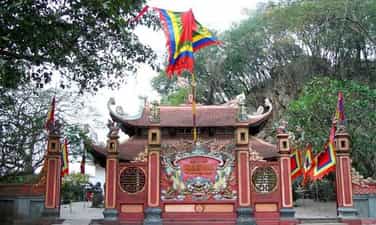
Temple of Truong Han Sieu
Truong Han Sieu Temple is located in the southwest of Duc Thuy Mountain, one side leans against the mountain, below is the lyrical Day River lazily flowing, winding from right to left, embracing the Temple area, creating a lyrical scene. , peaceful yet majestic. Truong Han Sieu (year of birth unknown) is from Yen Ninh district, Truong Yen district, now Ninh Binh city, Ninh Binh province. He was talented in literature and martial arts, rich in patriotism, and was respected by the kings of the Tran dynasty. Together with Nguyen Trung Ngan, he composed the Code of Laws "The Thuong Thu" and the book "Royal Trieu Dien", laying the foundation for the Vietnamese feudal regime to operate according to the law. When he died, he was posthumously awarded the title of Deputy Thai Viceroy and worshiped at the Temple of Literature - Quoc Tu Giam. When he died, a temple was built in the Southeast near his grave. But over time due to war, Truong Han Sieu temple was leveled. In early 1993, during the construction of houses in Van Giang ward, city residents discovered stone tablets and stone steles, column bases, and stone steps of the temple buried deep in the ground. On April 24, 1998, the construction of Truong Han Sieu temple officially started in the southwest area of Duc Thuy mountain. Truong Han Sieu Temple has a nail-style architecture, including 3 Bai Duong compartments and 2 Harem compartments, two floors of roofs covered with taro tiles, and the corners have curved knife heads. Looking at the edge of the roof, it rolls up at both ends like the image of a spectacular dragon boat. On the roof of the temple are two dragons flanking the moon. The front of the temple has a large inscription in Chinese characters "Truong Thang Phu Tu". Inside the altar is a bronze statue of Truong Han Sieu with a 1:1 ratio, sitting on a pedestal in Tran Dynasty costumes. The altar has a hammock door, an incense burner and two shelves with precious bowls on both sides. The last room of the harem has an incense burner to hold Truong Han Sieu's tablet. Every spring, Truong Han Sieu Temple is also a place where a large number of people in the province come to burn incense, sincerely ask for the New Year's blessing, with wishes for good things and luck in the new year. Truong Han Sieu Temple is located right next to Non Nuoc Mountain, one of the most famous tourist destinations in Ninh Binh. The temple worships Truong Han Sieu - a cultural celebrity and also a son of Ninh Binh. He was a man of "literature and martial arts", and together with scholar Nguyen Trung Ngan, composed the "Hinshu" law code. The Temple of Truong Han Sieu will always be living documents for generations to come. If you visit the ancient capital, don't forget to visit Truong Han Sieu temple to learn more about the roots of Vietnamese history. Future generations need to preserve cultural relics of historical significance because this is not simply preserving ancient architecture but is also related to the cultural history of an entire nation. Source: Electronic information page of Ninh Binh Department of Tourism Information Center
Ninh Binh
5087 view
Rating : National monument
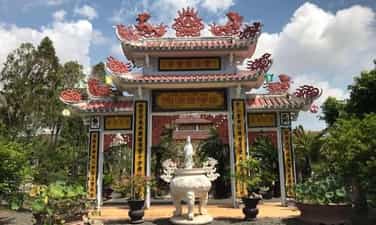
HISTORICAL RELIC OF LINH SON CO MIEU
Linh Son Ancient Temple is located at Thoi Hoa 1, Thoi Long Ward, O Mon District. This is not only the belief base of the Chinese people but also a solid Chinese foundation, contributing to protecting the revolution in the two resistance wars against foreign invaders. According to the elders, after a group of Chaozhou Chinese people came to Thoi Hung village (now Thoi Long ward) and saw the fertile land, they settled down to make a living here. In 1890, people decided to build the first temple made of leaves to worship Quan Thanh De, and at the same time create conditions for contact with Chinese groups far away from their homeland. In 1930, the temple was rebuilt firmly with wood and the roof was covered with yin and yang tiles. Later, it was renovated many times in 2002 and 2004, making the temple more and more spacious and carrying a certain aesthetic value. Linh Son Co Mieu is located on an area of 517.5 m2 and was built in the national-shaped architectural style, with rows of houses arranged perpendicular to each other including: front hall, natural yard, main hall, on the left of the temple is the state house. details, on the right is the gate to the Chinese cemetery, creating a space in the middle called Thien Tinh yard. The temple is surrounded by a fence with iron bars, the main side facing Bang Tang canal. On both sides of the door are a pair of tureens praising the saints worshiped at the Temple: “A thousand years of righteousness and bravery are unmatched. The eternal star is the number one person". The walls inside the Temple are decorated with paintings of Chinese classics, natural landscapes... creating a feeling of closeness and solemnity in the place of worship. The truss system is supported by 4 circular columns embossed in the shape of dragons called dragon pillars. Between the front hall and the quiet courtyard is a pair of "torches and cranes". Next is the Thien Tinh courtyard, the main hall decorated with blue "two dragons flanking the tai chi", below is a screen decorated with lions, mountain and river scenes, apricot, orchids, chrysanthemums, and bamboos symbolizing warm wishes. full, peaceful, happy. The main object of worship at Linh Son Co Mieu is Quan Thanh De Quan; In addition, Linh Son Co Mieu also worships the Earth God, the First Sage, the Later Sage... The worship statues at the Temple are carved in the style of round statues, very simple and rustic, expressing personality through each character's facial expressions, both close to mortals, while also carrying the majesty of the divine world. The architectural style and festivals at Linh Son Co Mieu have contributed to reflecting the typical folk culture of the Chinese people in Can Tho city. From 1950 - 1975, the main hall of Linh Son Co Mieu was also used as a meeting place for revolutionary cadres. Under the altar of the gods is a secret vault that can accommodate 4-5 people. The cellar door is right in the middle of the altar, previously disguised as the Earth God altar. Behind the wooden wall of the back office is also the exit to the cellar disguised by a hibiscus fence. Although many times suspicious enemies came to search everywhere in the Temple, thanks to skillful camouflage and the support of Chinese people, the revolutionary cadres were safely protected. Therefore, Linh Son Co Mieu is not only a religious base but also a historical relic recording the revolutionary struggle of the Chinese people in Can Tho. Linh Son Co Mieu was ranked as a historical relic by Can Tho City People's Committee on March 31, 2008. Source: Can Tho City People's Committee
Can Tho
5870 view
Rating : City-level relics

Am God
Am Chua is located on Dai An mountain, also known as Qua Son (Qua Lanh, Chua mountain, Cam mountain), the most common name Dai An in the past. Nui Chua is a mountain, 284 meters high. Am Chua is located halfway up the mountain, 80 meters above sea level, in Dai Dien Trung village, Dien Dien commune, Dien Khanh district, Khanh Hoa province. Up to now, there are no documents determining the specific time that Am Chua was built; But according to the story of local elders, Am Chua initially was a small hermitage located next to Dai An mountain pagoda on Hoa Son mountain and after many restorations, the hermitage became a place to worship Thien Y Thanh. The model is as spacious as today. Although the small pagoda named Dai An no longer exists, the blend of Mother Goddess worship and Buddhist rituals is still intact and is a typical cultural feature at Am Chua. The architectural system of worship at Am Chua has many similarities with the architecture of communal houses in Khanh Hoa. The worship structure has a coordination of worship and sacrifices that is similar to religious architectural works in the province and this is a religious feature of Khanh Hoa people. Architectural works at Am Chua include: Three gates, Mr. and Mrs. Tieu's tombs, inscriptions, Son Lam temple, Ngu Hanh temple, main hall. The main hall was restored for the third time in the year of the Dog (1958), the 4th time in the year of the Dragon (1988), and a major restoration in the year of the Ox (2009) with a three-room architectural form. The God Temple is decorated with altars, pairs of opposing tureens, and diaphragms carved delicately and sharply. The first altar is an incense altar worshiping the deity of Lady Tieu. The sacred altar of Thien Y Thanh Mau is splendidly decorated and is the most concentrated point of the worship structure in the Main Hall; On both sides are shrines worshiping the Six Immortals and the Twelve Immortals. On the left of the altar to worship the Holy Mother is the altar to worship the Four Crown Princes and the Twelve Executives, also known as the altar to Uncle (Prince Tri - son of the Holy Mother); On the right is the altar worshiping the Six Immortals and the Twelve Immortals, also known as the altar for the Lady (Princess Quy - daughter of Thanh Mau). All altars in the main hall are made of precious wood, carved with delicate and unique patterns and motifs. The entire main hall has a truss-style roof structure, rows of main columns and military columns made from highly valuable precious wood. Am Chua still retains two titles bestowed by the Nguyen Dynasty kings. According to folk beliefs, March is the month of Via Ba, "August is the anniversary of father's death, March is the anniversary of mother's death". Am Chua Festival is from the 1st to the 3rd day of the third lunar month every year and takes place according to a traditional process: Moc Duc (statue bathing) ceremony, Tam Hien Luong ceremony, main sacrificial ceremony, Van Mau singing, offering Female officials, Hau Thuong worshiping ceremony, incense offering ceremony and shadow dance. Through legends and folk tales, worship shows the continuity of culture and beliefs. Am Chua has brought within itself the values of the two cultures of Cham and Vietnam. Although there are different imprints, it must be affirmed that the image of Thien Y A Na is a Vietnamese creation, originating from the image of Po Nagar of the Cham people and originating from the image embodying the mother. creation of all species. With its tangible and intangible cultural values, in 1999 Am Chua was ranked by the State as a National Historical-Cultural Monument. Source: Ho Chi Minh Communist Youth Union, Khanh Hoa province
Khanh Hoa
5087 view
Rating : National monument
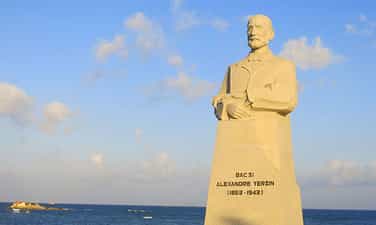
Memorial area of Dr. Alexandre Yersin
The memorial historical relic of scientist Alexan Dr Yersin was ranked as a National Monument by the Ministry of Culture, Information, Sports and Tourism on September 28, 1990. The relic is a complex of individual, typical, outstanding locations, directly linked to the life and career of scientist Alexan Dr Yersin, including 3 locations, which are the library at the Pasteur Institute of Nha Trang ( Tran Phu Street, Xuong Huan Ward, Nha Trang City), Linh Son Pagoda, Alexan Dr Yersin's grave (Suoi Cat Commune, Cam Lam District). Dr. Alexan Dr Yersin was born on September 22, 1863 in Switzerland. At the age of 20, he graduated from the University of Paris (France). In 1886, he worked at the Pasteur Institute in Paris and collaborated with Dr. Roux to find toxins. leukemic bacteria. In 1890, he was granted French citizenship. After he achieved certain successes in the medical field, Yersin suddenly left the field of microbiology - living a life of sailor and explorer - starting another life lasting 50 years. In 1891, he resigned from Messageries and went to Indochina to work as a physician for the Messageries shipping company to fulfill his dream of exploring new horizons. In July 1891, he came to Nha Trang for the first time. In 1895, Yersin founded the Nha Trang Pasteur Institute and prepared serum to cure the plague. A year later, the epidemic relapsed in China. Yersin went to China again and saved many people from the dangerous disease that killed 50 million people in ancient times. By the end of 1899, he returned to Nha Trang and established the Pasteur Institute. For nearly 50 years of living alone in Nha Trang, he devoted his entire life to his scientific career, successfully researching the production of medicine to cure the plague on June 20, 1894. Because he lived relatively simply and was close to the people of Con village, he was very loved by everyone. After that, he spent about two years (1902-1903) going to Hanoi to open the Indochina Medical College and become the first principal there. In 1924, he held the position of Inspector General of the Pasteur Institutes in Indochina. In 1933, he became honorary director of the Pasteur Institute in Paris. On June 28, 1935, Yersin High School was inaugurated in Da Lat, Yersin returned to Da Lat for the last time before his death. For the rest of his life, Yersin only lived and worked at the Pasteur Institute of Nha Trang. When he was old, he went to the top of the mountain above Suoi Dau to build a wooden house, grow medicinal plants, and research malaria medicine. Until his final days, he left a will with the wish to be buried in Suoi Dau. He would like to donate all of his assets to the Pasteur Institute of Nha Trang. On March 1, 1943, he died, the funeral was held very simply, many people came to see him off, following each other from Nha Trang to Suoi Dau. According to the will, when he was buried, people placed him on his stomach with his head facing the sea so that he would forever embrace his homeland. His tomb was built in a rectangular shape of cement, painted blue, with the words Alexan dr Yersin (1863. 1943) written on the surface. Source: Nha Trang tourism information portal
Khanh Hoa
5792 view
Rating : National monument
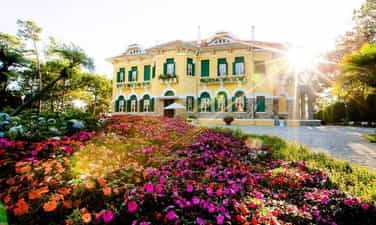
Bao Dai Palace 1
Da Lat is famous for 3 palaces during King Bao Dai's reign: Palace 1, Palace 2, Palace 3, associated with the ups and downs of our country's history. In 1940, a French millionaire named Robert Clément Bourgery built Palace 1. In 1949, King Bao Dai's father-in-law contributed money for the king to buy this mansion. King Bao Dai set up his General Headquarters here to work during his years as Head of State from 1949 to 1954. Besides Da Lat, King Bao Dai also owns another very famous mansion in Vung Tau, which is Bach Dinh. In 1956, Palace 1 was transferred to Ngo Dinh Diem for use. Many years later, this place became a resting place for heads of state until 1975. In 2014, the local government invested in restoring and repairing Palace 1, making this place available for sightseeing. vacation in Da Lat. Palace 1 of Da Lat (Bao Dai Palace) has undergone many renovations. The outside campus is spaciously designed and equipped with luxurious tables and chairs. Stepping through the gate into the campus, there are hundreds of blooming flowers, a giant flag garden, 7-color steps, hundreds of hanging lanterns... The fountain has a bold European feel as well. attracts many tourists. Stepping up to the first floor, in addition to the main lobby area, on both sides of the palace are 2 large living rooms, behind are 4 rooms of different sizes. In the past, these rooms were used as transition rooms, clerical rooms, kitchens and WCs. At the end of the first floor is a very majestic and magnificent photography room. Including a throne, a hammock painted in red and gold... When you step up to the 2nd floor of Bao Dai Palace 1, you will see 3 different bedrooms. The first room is the bedroom of King Bao Dai's mother (Mrs. Tu Cung). The second room is King Bao Dai's bedroom. Next is Queen Nam Phuong's bedroom, located opposite the palace hallway. It can be said that the second room is the most important in King Bao Dai's first palace. This is where important meetings took place during the reign of King Bao Dai from 1949 to 1954. This is also the place to discuss campaigns and wars from 1955 to 1963. During Ngo Dinh Diem's government, he renovated King Bao Dai's room and dug a secret tunnel here. The path down to the tunnel is disguised to look like a bookshelf to the right of the bed. This exit leads to the helipad behind the hill of palace 1. Especially in this mansion are military-style constructions, you will not help but be surprised and overwhelmed by its unique appearance. First is a large helicopter landing pad, gas depot, and emergency exit (tunnel). The tunnel door is equipped with metal weighing several hundred kilograms, artillery, bulletproof glass... Source: Da Lat tourism information portal
Lam Dong
6534 view
Rating : National monument

Relics of Resistance Base Area 6 Cat Tien
The historical relic site of resistance base in Cat Tien zone VI has a total area of nearly 50 hectares, located in village 5, Duc Pho commune, Cat Tien district, Lam Dong province. This is an ideal address to attract people and tourists who love nature, explore and learn about history and national revolutionary traditions. Area VI relic, Cat Tien is a work of important historical significance, recording the merits and achievements of generations of ancestors in the struggle against the American invaders, period 1963 - 1966. Mold The relic site of Area VI, Cat Tien is designed harmoniously, scientifically and beautifully, suitable for the landscape space, with a system of clean, beautiful concrete-paved internal roads winding around cool, green ponds and lakes; The majestic monument located on the top of the central hill has created a highlight that attracts the attention of people and tourists when visiting the relics of Area VI, Cat Tien. Not far from Monument Hill is a display house with 108 collected artifacts and a number of primitive weapons restored for display and explanation. Scattered on the green hillsides shaded by forest trees are buildings of camps and shelters recreating the working and living spaces of "Region and Military Region Party Committee agencies" with a total of 23 categories. categories, in which, the Regional Party Committee agency has 12 categories and the Military Region agency has 11 categories. According to historical documents, in the period from 1963 - 1966, Cat Tien Party Committee and Zone VI made important contributions marking the continuous growth of our country's revolutionary forces. In the beginning, Area VI was the place to focus on consolidating and preparing the necessary conditions to coordinate with the entire South to attack the enemy, destroy strategic hamlets, expand the controlled and liberated areas, and create position and force. for the Vietnamese revolutionary movement to win great victories. Especially in the Winter - Spring of 1964 - 1965, the revolutionary movement in Area VI had a leap forward in both width and depth; The army and people of Zone VI proactively coordinated with the entire South to attack the enemy in the Dong Xoai campaign in the summer of 1965, contributing to the bankruptcy of the US imperialism's "special war" strategy. In the dry season of 1965 - 1966, the army and people of Zone VI defeated the enemy's first counterattack in the Zone VI battlefield. From here, the army and people of Zone VI continuously failed the enemy's pacification and search-and-destroy plan in the second strategic dry season counterattack (1966 - 1967). By the dry season of 1967 - 1968, the army and people of the Zone VI stepped up its attacks and won great victories. From mid-1965 to the end of 1968, the Party Committee, army and people of Region VI coordinated with the entire region to defeat the "Local War" strategy of the US imperialists. The victories of the army and people of Zone VI - Cat Tien demonstrate the Party's ingenious and wise leadership. Among them, the ethnic community of Zone VI was united, heroic, and indomitable, achieving resounding victories, demonstrating the brilliance of revolutionary heroism, and with passionate patriotism helping the army. and the people of Area VI overcame countless difficulties and challenges, winning victory after victory in the resistance war against the US to save the country, contributing to completely liberating the South and reunifying the country. The construction and embellishment of the historical relics of the resistance base of Zone VI, Cat Tien has shown the spirit of drinking water, remembering the source, honoring and promoting the great historical values of the army and people of Zone VI, and the community. This is the place to educate, train and foster revolutionary traditions for future generations. Source: Cat Tien District Electronic Information Page
Lam Dong
10111 view
Rating : Special national monument
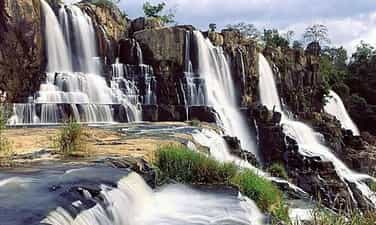
Datanla waterfall relic area
National historical and cultural relic tourist area Da tang la waterfall, also known as Da tan la, is a famous waterfall in Da Lat city, Lam Dong province, Vietnam. Located in the Da Tan La tourist area, the waterfall is 8 km from Prenn waterfall and about 10 km from Da Lat city center. Da Tang La Waterfall is considered one of the ideal destinations for tourists who want to visit and experience adventure. The name "Da tang la" or "Da tang la" is taken from the K'Ho language, made up of the word "Da-Tam-N'ha", meaning "there is water under the leaves". This name originates from the historical conflict between the Cham - Lach - Chil peoples in the 15th century. to the 17th century. Da Tang La Waterfall has abundant water thanks to a stable water source from upstream. Not as noisy as some other waterfalls, Da Tang La flows through many stone shelves and falls from rapids about 20m high. The lower part of the waterfall forms a very clear water area, called Suoi Tien, while the upper part has a deep pool called the Death Abyss. According to legend, because this abyss is located in the middle of a mountainous area, it was once a refuge for an army of the indigenous people during the war with the Cham people hundreds of years ago. There are many legends about the origin and meaning of Da Tang La waterfall. One of them tells about the meeting of the brave warrior K'Lang and the mountain girl Hobilang here. Some other legends about Da Tang La waterfall say that the waterfall is the place where fairies often bathe, or the story about the war between the Lat and Cham people, in which the waterfall played an important role in the fighting strategy of the people. Surname. With those cultural values, in 1998, Da Tang La Waterfall was recognized by our state as one of the famous landscapes and historical relics in Da Lat, ranked as a national monument. . Source: Da Lat tourism information portal
Lam Dong
5051 view
Rating : National monument
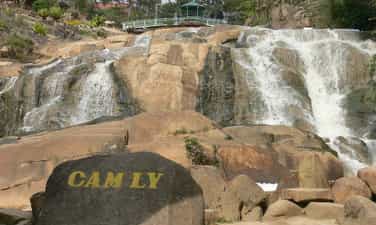
Historical relic of Cam Ly Waterfall in Dalat
Cam Ly Waterfall is located 2km west of Da Lat city. This is considered the waterfall located closest to the city center. Cam Ly waterfall is located next to Cam Le stream, the waterfall is formed from part of the water flowing in from Xuan Huong lake and another stream, Cam Ly stream, also flows here. Cam Ly Waterfall is one of the waterfalls that talks about the remembrance, gratitude, and respect of the people here for people with meritorious services during that period. Legend has it that Cam Ly waterfall originated from the K'Ho language. People in the Lach (Lat) tribe call Cam Ly waterfall Lieng To Sra - the boundary of Cam Le stream to Da Dong river. People in the new village took the name of the chief of the Lach (Lat) tribe at that time, K'Mly, to commemorate and show the villagers' gratitude to this chief. This chief took care of the meals and sleep of the entire tribe, lived in harmony with the people, and took care that the lives of the people in the village became prosperous, prosperous, and complete. So the name of this chief given to the waterfall was K'MLy, later pronounced Cam Ly. According to the Sino-Vietnamese origin, Cam Ly means stream with fresh water (Cam means sweet, Ly means permeable). Cam Ly Waterfall possesses poetic beauty, especially in the rainy season when the water flows rapidly, creating huge blocks of water pouring down violently. With a convenient location near the city center, Cam Ly waterfall attracts a large number of tourists every year. At the foot of Cam Ly waterfall is a small flower garden, contributing to creating a harmonious and beautiful landscape. In addition, in the waterfall area there is also Nguyen Huu Hao mausoleum, built with many unique architecture. In 1998, Cam Ly Waterfall was ranked by our state as a scenic spot and historical relic in Da Lat, recognized as a national monument. Source: Da Lat tourism information portal
Lam Dong
5046 view
Rating : National monument