Relic point Vietnam
Việt Nam
Dinh Phong Coc
Phong Coc Communal House, also known as Coc Communal House, is so named because the communal house is located on a land shaped like a Coc bird, at the border between Phong Coc commune and Phong Hai commune, Yen Hung district, Quang Ninh province. Formerly Phong Coc village, Phong Luu commune, Yen Hung district. Phong Coc communal house and Phong Coc temple are a relic complex in Phong Coc commune, Yen Hung district. Every year, the villagers organize a ceremony to pray for rain and process the four Saint Nuongs from Phong Coc temple to the communal house to pray and then take them back to the temple. During land reform, the temple collapsed and local people brought the four monks to the communal house to worship. Up to now, Phong Coc Temple has been invested in repairing and restoring and has been ranked at the National level according to Decision No. 25/2007/QD-BVHTT, dated August 3, 2007. Dinh Coc is the place to worship the Phong Coc village god and the Nong god. According to legend, the current Phong Coc village god was originally a Vietnamese from Chau Hoan (ie Nghe Tinh) in Dai Kien estuary, Huong Cat commune. During the Ly Dynasty, after his death, local people built a temple at the Huong Cat estuary. Dinh Coc's current architecture consists of 3 houses: Front Street, Bai Duong and Hau Palace. The front hall was built in 1805 (Gia Long's fourth year). The worship hall was built in 1801 (ie Canh Thinh eight years). During the reign of King Tran Anh Ton, after the victory in Champa, the king gave 300 mandarins funds to repair the communal house. During the Le Dinh period, temples and tombs continued to be restored. Although it has undergone many restorations, repairs, and anti-degradation, the communal house still retains the original elements that make up the monument intact. Coc Communal House has typical architectural and artistic values. The structure is mainly made of wood with many carved delicate lines, rich images, and a generous layout in the style of the Le Dynasty with many living themes such as four sacred animals, cockfighting, wrestling, boating, and walking. festival... . The carvings of Phong Coc communal house have depth in both space, color and content, expressed by techniques of channel carving, filigree carving, shallow carving... With typical architectural and artistic values, Phong Coc communal house has been ranked at the National level by the Ministry of Culture and Information (now the Ministry of Culture, Sports and Tourism) according to Decision No. 191/VH-QD, dated March 22, 1988. Source Quang Ninh province electronic information portal.
Quang Ninh
5043 view
Rating : National monument
Quan Dai Temple
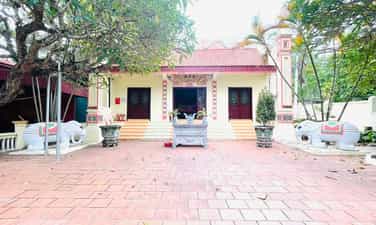
Quan Dai Temple is located in La Khe village, Tien An commune, Quang Yen town, worshiping two great mandarins of the Nguyen Dynasty, Truong Quoc Dung and Van Duc Giai, who commanded soldiers and people of Quang Yen to expel bandits. The country and his minions of the French colonialists to protect the border and islands in the Northeast region of the Fatherland. Quan Dai Temple is located in La Khe village, Tien An commune, Quang Yen town, worshiping two great mandarins of the Nguyen Dynasty, Truong Quoc Dung and Van Duc Giai, who commanded soldiers and people of Quang Yen to expel bandits. The country and his minions of the French colonialists to protect the border and islands in the Northeast region of the Fatherland. Legend has it that after the two men died in battle, their two elephants took their masters into the bamboo forest (where people built the temple today), stomped through a section of the bamboo forest to place the bodies of the two commanders, and then lay down. next to. When people heard the news and went to bury it, they saw termites forming two large graves. The two elephants also fasted and died along with their owners. To show gratitude to the two mandarins who sacrificed their lives for the people and the country, the people in the village built a temple to worship them, offering incense and smoke all year round (the temple worships the two loyal mandarins, so people in the area still called Song Trung tu). People in the area took the day of their death as the day to open the temple festival, also known as the "death anniversary" - the big festival of La Khe village. According to archaeological documents, Quan Dai temple originally had Nhi-style architecture. Over time, the temple was destroyed, only the foundation and tombstones remained. Today's temple was built in 1993 by Tien An people with contributions and contributions, with three worship rooms and three harem rooms. Currently, the temple still preserves many artifacts of historical and cultural value of two famous people, such as inscriptions, ordinations, photos, worship objects... of two heroic heroes Truong Quoc Dung and Van Duc. Giai... Source Quang Ninh province electronic information portal.
Quang Ninh
4831 view
Rating : National monument

Dinh Hai Yen
Hai Yen communal house has the literal name "Hai Yen communal house" in the West hamlet (Hamlet) of Hai Yen village, Yen Hai commune, Yen Hung district, Quang Ninh province. Hai Yen village was formerly called Hai Trien. Hai Trien village was established during the Le dynasty by some residents in Tuan Chau and Hai Duong who came to build the sea dyke. In the early 19th century, Hai Trien was changed to Hai Yen. According to Han Nom documents, Hai Yen communal house was built in the Later Le period, by the people in the village contributing money and effort to build it. The communal house has undergone many restorations and special repairs in 1815 under the Gia Long era and in 1963 a large-scale restoration was organized. Based on the decrees bestowed on Hai Yen communal house by the kings of the Nguyen Dynasty, the communal house's tutelary gods are three deities: Dieu Cam Mo Phu, Chuong Hien Don Dinh, Duc Bao Trung Hung, and Linh Ung as Tutelary God Linh Ung Chi. god; Wing Bao in the middle of the golden talisman resembles the imperial god of Uy Minh; Wing Bao Trung revives the spirit of the land, tutelary god Dai Hai Pham Chi. But now only the miracle of one god remains: "God of Dai Hai Pham". The god of Dai Hai Pham is Pham Tu Nghi. He was a military general of the Mac Dynasty, his given name was Pham Thanh, and his given name was Tu Nghi. He is a talented general. After his death, feudal dynasties made him a god. The people of Hai Trien village (present-day Hai Yen) honored him as the Tutelary God and worshiped him at the village communal house. Hai Yen communal house is a majestic village communal house, located in the middle of a rich and densely populated village. The communal house has a unique architecture, wooden structure, tiled roof, four curved roofs like the bows of boats moving through the waves, the rafters are firmly linked together, and the elaborate and skillful carvings Cleverly with dragons, clouds, flowers, four sacred animals... creating a vivid and attractive picture. This is a unique artistic architectural work with characteristics of the Later Le period in the early 18th century. Although it has been 300 years since its inception, with investment in restoration and embellishment over time, the communal house still retains its traditional architectural features relatively intact. With typical architectural and artistic value, Hai Yen communal house has been ranked at the national level by the Ministry of Culture and Information according to Decision No. 59/2003/QD-BVHTT, dated October 29, 2003. Source Quang Ninh province electronic information portal.
Quang Ninh
5051 view
Rating : National monument

TIEN CONG TEMPLE
Tien Cong Temple (also known as Thap Nine Tien Cong Temple) is located in Cam Thanh Village, Cam La Commune, about 5km from the town center, worshiping 17 "Thap That Tien Cong" immortals, from Kim Hoa Ward, Phu Quoc. Hoai Duc, Thang Long citadel. These are the people who made the first contributions to the cause of dikes and river encroachment to establish the Ha Nam island area, including Cam La commune. Formerly, the Tien Cong Temple was a temple to worship 19 Tien Cong who were the first to build the sea dike to establish the island of Hao Nam - Yen Hung in 1434. The Tien Cong temples are worshiped at the Temple including: Vu Song, Vu Hong Tiem , Bui Huy Ngoan, Ngo Bach Doan, Nguyen Phuc Coc, Nguyen Phuc Thang, Nguyen Phuc Vinh, Le Khep, Le Open, Vu Tam Tinh, Vu Giai, Nguyen Nghe, Nguyen Thuc, Bui Bach Nien, Pham Viet, Duong Quang Tin , Duong Quang Tan, Hoang Nong, Hoang Nenh. However, currently there are still 17 people whose hometowns were originally from Kim Hoa ward, Hoai Duc district, Hanoi who are worshiped at the temple, because the people of Trung Ban village gave 2 tablets of 2 Tien Cong Hoang Nong and Hoang Nenh as their ancestors. of our commune to worship at "Tien Cong Co Mieu" in Trung Ban village. Tien Cong Temple worshiping Thap That Tien Cong dates back to the Later Le Dynasty on the current location, but was originally made of a house with mud walls and bamboo thatch. It was not until the third year of King Gia Long's reign (1804) that it was built with spacious bricks and tiles. The temple was built on a high area of land, facing east, with an area of 2,912 square meters, 2-letter architecture (=), 3-compartment, 2-left structure, and funny-nosed tiled roof. In front is the worshiping hall, next is the yard, behind is the ancestral church. The architecture in the temple clearly shows the architectural art style of the Nguyen Dynasty. Tien Cong Temple has undergone many restorations, most recently in 1804, 1920, 1931, 1946, 1994. At the altar, on the altar, there is still a large engraving engraved with four letters of King Tu Duc's ordination in his 28th year, "Phong Luu Nghia Dan" and a wooden ordination of King Khai Dinh in his 9th year, ordaining 17 Immortals. Cong is the "God of the Winged Treasure of the Middle Ages" In the Temple there are a couple of notable couplets: Since ancient times, work has been established forever A year of worship and prosperity Meaning: The work of farming will last forever Thousands of years of worship are extremely blessed Tien Cong Temple not only has historical and cultural value, but is also an art "Museum" displaying very valuable wood sculpture artifacts. In addition to the traditional carvings shown on the trusses, trap ends, beam ends, beams... the worship objects here demonstrate the virtuosity of fine carpentry of the local people. The altars, ordinations, incense burners, and precious bowls are all painted and gilded. The carved lines on worship objects, from tablets to altars, hammock doors, great characters, and parallel sentences, all bear the unique characteristics of the nation's cultural identity with many stylish themes. rich and diverse such as four sacred animals, tigers, dragons, stylized flowers and leaves, rattan, carp turning into dragons... all create a sacred and respectful look. Tien Cong Temple was recognized by the State as a Historical & Cultural Relic in 1989. Source Quang Ninh province electronic information portal.
Quang Ninh
4977 view
Rating : National monument

Po Hen historical relic site
Po Hen historical relic site is the place to record the heroic and heroic fighting moments of our army and people, the battle to protect the sacred sovereignty of the Fatherland. February 17, 1979 has gone down in Vietnam's history as a tragic song about the heroic, indomitable, and steadfast spirit of the people on the ground who did not spare blood and bones, ready to sacrifice to protect national border sovereignty. In that war, 73 soldiers heroically sacrificed their lives to protect the integrity of the country's territorial sovereignty and sacred borders. Typical examples include: Deputy Lieutenant Do Sy Hoa, although injured, he still did not leave the battlefield, fighting until his last breath; Soldier Nong Van Dieu - The person who discovered the enemy earliest and took the lead in fighting the enemy when they first started attacking the station gate; Soldier Hoang Van Tuc stubbornly fought until he ran out of bullets and then went to another point of the unit to fight and sacrifice in a fighting position; Hoang Thi Hong Chiem - The brave daughter of Mong Cai - Hai Ninh commercial worker who heroically sacrificed herself to protect her homeland, protect the borders of the Vietnamese Fatherland... With outstanding achievements in In the struggle to protect the Fatherland, on December 19, 1979, officers and soldiers of Border Guard Station 209 Po Hen were awarded the title of Hero of the People's Armed Forces by the President of the Socialist Republic of Vietnam. After the events of February 1979, Station 209 Po Hen moved to a new location. Po Hen Martyrs Memorial Area, construction began on May 19, 2010, on the occasion of Uncle Ho's 110th birthday and was inaugurated on January 10, 2011; This project is 100% socialized mobilization, invested by the Quang Ninh Province BP Command, with the donation of funds and facilities from groups, units and individuals in all parts of the country. with deep gratitude. The memorial faces North, with a total campus area of 86,304 square meters, including the main construction items: memorial, incense burner, stele house, memorial yard and garden; 16 meters high, built of reinforced concrete, covered with white stone. On both sides are two stele houses, inside there is a stele made of monolithic green stone engraved with the names of 86 martyrs who are border guards of Station 209 Po Hen, commercial staff and Hai Son forestry workers. Every year, on holidays, New Year, anniversaries, traditional days and on the occasion of local political events, activities "Appreciation to fallen heroes" are held here. The Po Hen historical relic site is not only historical evidence of the spirit, determination, and brave and tenacious fighting to protect the sovereignty of every inch of sacred land at the borders of the Fatherland and of the country. collective of officers and soldiers of Border Guard Station 209 Po Hen, of the collective of officers and employees of Lam Truong and the people here. This is also a red address to educate patriotic traditions at the border. The relic is ranked at the provincial level according to Decision No. 178/QD-UBND dated January 23, 2014 and ranked at the National level according to Decision No. 2288/QD-BVHTTDL dated September 20, 2022 and assigned to the Border Guard Station. Directly managed by Po Hen. Source Electronic information portal of Mong Cai city, Quang Ninh province.
Quang Ninh
5513 view
Rating : National monument
Xa Tac Temple.
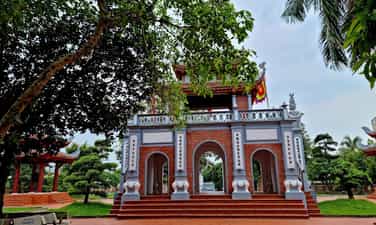
Xa Tac Temple is located in a special location, next to the bank of Ka Long River (Vietnam - China border), in area 3 of Ka Long ward, Mong Cai city. In 2005, Xa Tac temple relic was recognized as a Provincial relic - according to decision No. 2332/QD-UBND of Quang Ninh province dated July 18, 2005. According to the Monument Classification File, the Temple was built around the late 13th and early 14th centuries during the Tran Dynasty to worship the god Xa Tac - the Tutelary God of the ancient Mong Cai continent. Here, we worship Xa Tac Dai Vuong, Hung Nhuong Dai Vuong Tran Quoc Tang, Cao Son Dai Vuong, the Dragon Earth God of the village and the pioneers of the families who have contributed to exploiting this land. In 2005, the temple was ranked by the People's Committee of Quang Ninh province as a provincial historical-cultural relic. According to the elders living around this area, in the past, Xa Tac Temple was built at the edge of the Thac Mang River on a fairly large scale including three houses, facing south, with yin and yang tiled roofs. In the early twentieth century, during a big storm, the Temple collapsed and people moved into the Vortex area on a smaller scale than before. Through the ups and downs of time, up to now, the temple has been restored many times, the biggest restoration was in the year of the Cat 1879. During the Northern border war in 1979, the temple was destroyed, only A few steles and old foundations remain. After 1989, the temple was restored on a small scale. To meet the wishes of the people who want a spacious and large worship facility, in 2009, Xa Tac Temple was decided by the People's Committee of Quang Ninh province to allow restoration and hand over to the People's Committee of Mong city. The investor of phase I and BTS is the Quang Ninh province Buddhist Sangha as the investor of phase II, implementing the project with socialized capital. Today's Xa Tac Temple is built in the south direction, on a high, airy plot of land with a campus area of about 20,000 m2, the east borders the Ka Long river, the remaining three sides border the leased land area of the joint company. Hong Van hotel business. The main temple has an area of 308 m2, built in the style of the letter "cong". In which: the front hall consists of three rooms, two wings, two common rooms and three back rooms. The temple is built mainly of ironwood, the roof is tiled with dragon scales, and the walls are brick. The temple is built with two floors and eight roofs with traditional, sophisticated carved patterns, and the roof is covered with funny-nosed tiles. Currently, Xa Tac Temple still retains three ancient steles dating back to 1879, on which are recorded the names of those who contributed money and contributions to restore and rebuild the temple. Xa Tac Temple is a large-scale historical and cultural relic with a long history. This used to be a place for sacred religious and spiritual activities of residents of Mong Cai and surrounding areas, in addition to the full moon and first lunar month worship days. Every year, five main holidays take place at the temple: January 16, May 2, August 16, December 16, December 18 (AL). During these days, people in the area are divided into 5 groups. During a year, each group is assigned to take care of one main ceremony. January 16 is a day of praying for peace. The Ministry of Culture, Sports and Tourism has just issued Decision No. 3238/QD-BVHTTDL dated November 4, 2020 on the National Relic ranking of Xa Tac Temple Historical Relic (Ka Long Ward, City). Mong Cai, Quang Ninh province). Source Electronic information portal of Mong Cai city, Quang Ninh province.
Quang Ninh
5026 view
Rating : National monument

Nam Tho Pagoda (Van Linh Khanh Tu)
Nam Tho Pagoda (also known as Van Linh Khanh Tu), located in Nam Tho area, Tra Co ward, is one of the typical valuable relics of Mong Cai city, ranked as a relic by the Ministry of Culture and Information. National level art achievement in 1999. According to the inscription on the recast bronze bell, the pagoda dates back to the 3rd Thieu Tri (1843), in the 15th year of Canh Thinh's reign of King Le Hien Tong (1754). Nam Tho Pagoda was built facing north, with a Muslim-style structure meaning the convergence of water streams. That is also the explanation for the pagoda's name: Van Linh Khanh (Sacred, good). Nam Tho Pagoda includes the main buildings: Three Entrances, Ancestor House, Mother House, Guest House; It has been restored many times, the mark of the Le Dynasty is no longer there. But here a system of 53 ancient statues is still preserved. Most notable are the 4 statues of newborn Sakyamuni, 2 statues of Quan Am Tong Tu and 2 small statues of the Three Worlds bearing the cultural identity of the Vietnamese people. That is why this place is a miniature "ancient sculpture museum" of the Northeast region of Vietnam. Another special feature of Nam Tho Pagoda that few relics have is the ancient forest behind the pagoda. Not only is it a place for cultural and religious activities of local people, Nam Tho Pagoda is also a historical and cultural relic associated with the process of our people's struggle to protect the homeland and build the country. . In 1905, Phan Boi Chau was on his way to China to meet with Japanese revolutionaries. China asked them to support the Dong Du movement. Once while being chased by the enemy, he took refuge at Nam Tho pagoda and was sheltered and helped by the people. During the two resistance wars against the French colonialists and the American Empire, the pagoda was a place to store food, hide grassroots cadres, hide revolutionary documents, and was a place to send off thousands of local children on their journey. join the resistance. In 2014, the People's Committee of Quang Ninh province signed a decision approving the project to renovate, restore and restore Nam Tho pagoda relics with a total socialized investment capital of over 12 billion VND. Located in an important position at the beginning of the country, Nam Tho Pagoda as well as other artistic and cultural architectural works of Mong Cai city are a solid "landmark" affirming national territorial sovereignty, overcoming marking history and imbuing the typical cultural features of the Vietnamese people in the border areas of the Fatherland. Source Electronic information portal of Mong Cai city, Quang Ninh province.
Quang Ninh
4303 view
Rating : National monument

HISTORICAL REVOLUTIONARY RELIC OF MAO KHE MINE AREA
The mine's revolutionary historical relics include 03 points: + First location: Place where the first Party Cell was established at the mine (Democratic Area) + Second location: Mechanical workshop - Mao Khe mine, where members of the revolutionary youth association Hoi - led by Comrade Hoang Quoc Viet (ie Hang Ba Cang), conducted the proletarianization - This is the policy of propagandizing, training and spreading Marxist-Leninist ideology to the working class in the mining area, creating conditions for the formation of higher organizations of Mao Khe mine workers in the future. + Third address: Non Dong Pagoda: Was a secret base of the Indochina communist organization in the years 1929 - 1930. The 3 locations of the Mao Khe Coal Mine Historical Relic are places that mark the activities of patriotic scholar Nguyen Van Cu and are also where the first Party Cell was established in the Quang Ninh Mine Area. Among them, Non Dong pagoda is recorded in history books from the year Trung Hung 1285; The mechanical factory operated during the French colonial period. Over time, these locations have been damaged and are only ruins. In 2015, from many capital sources, Quang Ninh province started a project to restore and embellish the historic Mao Khe coal mine. Currently, Mao Khe Coal Mine historical relic is one of 14 tourist destinations in Dong Trieu town. The Ministry of Culture, Sports and Tourism has just issued Decision No. 3013/QD-BVHTTDL dated August 30, 2019 on classifying the Mao Khe Coal Mine Historical Relic (Mao Khe Ward, Dong Trieu Town) as a national monument. ). Source Department of Culture and Sports of Quang Ninh province.
Quang Ninh
4582 view
Rating : National monument
Cao Dong Trieu Fort Relics
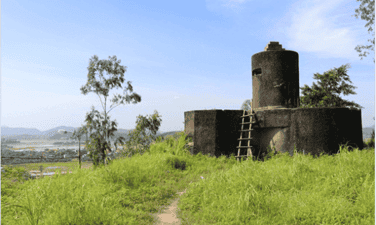
Cao Dong Trieu Fort is located on a hill with an altitude of 61m, with a total area of over 145,000 m2. This is a base built by the French colonialists to house the command center of the French colonial regime for Dong Trieu in particular during the period of French colonial rule. Along with Ho Lao Communal House and Bac Ma Pagoda, Don Cao is one of the places associated with the formation and birth of Tran Hung Dao War Zone - Dong Trieu War Zone. National historical relic Cao Dong Trieu Fort is located on a hill with an altitude of 61m, with a total area of over 145,000 m2. This is a base built by the French colonialists to house the command center of the French colonial regime for Dong Trieu in particular during the period of French colonial rule. This place has also entered the history of the Party Committee, government and people of Dong Trieu town's ethnic groups. Cao Dong Trieu Fort relic is the highest position in the center of Dong Trieu ward. Fort Cao is located on the main traffic route from Chi Linh, Hai Duong to Uong Bi Quang Ninh, from Kinh Mon, Hai Duong via Trieu ferry to Dong Trieu. From Dong Trieu Cao Station, it is possible to remotely observe and detect targets from the North to the South and from the East to the West of the town. Therefore, after invading Vietnam, in 1896 the French colonialists organized the construction of a military camp here to serve the war of invasion and exploit mineral resources in Dong Trieu. In 1945, our people seized power, Cao Dong Trieu station came under the management of the revolutionary government. On the morning of June 8, 1945, Cao Dong Trieu Fort was captured by the Fourth War Zone insurgents under the command of Lieutenant General Nguyen Binh, opening the August revolutionary climax in the entire region. The insurgents started from Bac Ma Pagoda, after capturing Cao Dong Trieu Fort, gathered at Ho Lao communal house. Here, on behalf of the Central Committee, Lieutenant General Nguyen Binh announced the establishment of the Tran Hung Dao resistance war zone, also known as the Fourth War Zone. In 1947, the French colonialists continuously launched major battles to retake Dong Trieu. This time, wherever they occupy, they immediately build and reinforce a system of watchtower posts and towers, aiming for long-term occupation and controlling our forces to fight back from afar. By May 7, 1954, the Dien Bien Phu campaign was completely victorious and Don Cao was under our control. Over a long period of time, many of the buildings belonging to the Dong Trieu Cao Fort relic site have been destroyed, leaving only a part of the buildings remaining such as the Ba mandarin's house, the green loincloth soldier's house and the house solitary confinement and torture of Communist prisoners, artillery barrages, blockhouse systems, underground bunkers... The vestiges here are still important evidence marking an unforgettable historical period of the entire nation in general, of Party committee and people of Dong Trieu in particular. On May 24, 2017, Don Cao relic was decided to rank as a national historical relic by the Ministry of Culture, Sports and Tourism. In the future, Don Cao will be repaired and restored. Source Quang Ninh province electronic information portal.
Quang Ninh
4269 view
Rating : National monument

Le Chan Temple (An Bien Temple)
The temple worshiping female general Le Chan (An Bien temple) is located on the slopes of Ven mountain in ancient Ven village, An Bien village, Thuy An commune, Dong Trieu town. This is where female general Le Chan was born and grew up during her childhood years with her parents. When she passed away, the people remembered her great contributions and built a temple right in her homeland to worship Mrs. Le Chan, a beautiful and talented female general who led the people to stand up and fight the enemy during the resistance. fight against Northern domination under the Trung Sisters. From a brave general fighting the enemy, female general Le Chan became a Holy Mother in the sense of folk beliefs, a special cultural phenomenon. When Le Chan passed away, her temples were established in many places in provinces such as Quang Ninh, Ha Nam, Hai Phong, Hanoi... In 2006, An Bien temple was ranked as a provincial-level historical and cultural relic. In 2017, it was ranked as a National Historical Monument. In 2018, on the occasion of the victory anniversary of Female General Le Chan (August 15 of the lunar calendar), Dong Trieu Town held a groundbreaking ceremony and started construction of the main temple. After nearly 3 years of repairing and embellishing the monument, in early 2021, the main temple, ritual gate and spacious temple yard were completed as they are today. The festival takes place for 3 days, from March 16 to 18 every year. Source Quang Ninh province electronic information portal.
Quang Ninh
4193 view
Rating : National monument