Relic point Vietnam
Việt Nam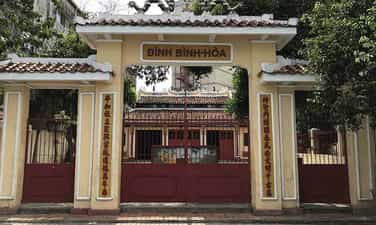
Binh Hoa Communal House
Binh Hoa communal house is located close to provincial road 26, in Binh Ninh hamlet, old Binh Hoa commune, now provincial road 88, hamlet 5A, Giong Trom Town, Giong Trom district, Ben Tre province. Binh Hoa Communal House was first built in 1812. The communal house was built by people from simple materials such as trees, leaves, and bamboo to worship the village's tutelary god. In 1852, Binh Hoa Communal House in Ben Tre was ordained by King Tu Duc. This is a very meaningful ceremony when the gods worshiped in the communal house receive recognition from the king. Since then, the communal house has become more known to the people, they come here to celebrate mass to pray for peace and luck. By 1903, the celebration committee stood up to organize and mobilize people to contribute effort and money to rebuild Ben Tre Binh Hoa Communal House on a larger scale. The construction process took 10 years, from 1903 to 1913, when it was completed. The main material used is four iron wood, the structure is attached with tenons and dowels, absolutely no nails are used. This is a very familiar style of pagoda construction during the Nguyen Dynasty. Although rudimentary, it is still extremely sturdy. On December 25, 1959 of the lunar calendar, a Ngo Quyen police regiment commanded by Le Xuan Khanh came from Ben Tre to station here. They used Binh Hoa communal house as a place to imprison and torture our revolutionary soldiers and compatriots. The Wei army used many brutal and cruel forms of torture. According to some records, the total number of compatriots they captured here, tortured and killed was more than 400 people. The hundred-year-old communal house has witnessed the blood of countless compatriots shed, and is also a historical witness to the crimes of the enemy. By 2012, Binh Hoa communal house was restored by the Department of Culture, Sports and Tourism of Ben Tre province in conjunction with the People's Committee of Giong Trom district. The process of renovating the monument lasted for 1 year, retaining the characteristics of the communal house but expanding its scale and building additional auxiliary works to serve visitors and tourists. When completed, the total area of Binh Hoa communal house is 9,000m2 with main items including: martial arts house, incense burner, main hall, lobby, corridor, back hall, Quan Thanh temple. Currently, Binh Hoa communal house still preserves more than 100 exquisite wooden sculptures including horizontal panels, parallel tureens, bamboo panels, reliefs, and incense burners. Binh Hoa Communal House was ranked as a National Historical, Cultural, Architectural and Artistic Monument on January 7, 1993. Source: Summary of Ben Tre tourism newspaper
Vinh Long
9110 view
Rating : National monument

Tan Thach Communal House
Tan Thach Communal House is in Hamlet 9, Tan Thach Commune, Chau Thanh District, Ben Tre Province. Tan Thach communal house was built in 1841, at that time it was called Thach Ho communal house. The communal house was built to worship the village's Thanh Hoang. The structure of the village communal house is in the shape of the letter Tam (三) with three main spaces, Vo Ca, Vo Quy and Main Hall, adjacent to each other. Tan Thach communal house has a campus area of about more than 7,600 square meters. In particular, the area of the communal house is 1,250m2. The communal house was built with traditional architecture, the roof is covered with yin and yang tiles, decorated with familiar images such as two dragons with pearl paintings, carp turning into dragons and eight immortals. The three-entrance gate of Tan Thach Communal House is built of bricks and cement, the roof is tiled, and on the roof are images of two white porcelain dragons. The gate is designed into three doors with the main door in the middle. According to folk beliefs, the main gate is for monks, kings, and mandarins to come to the communal house to offer incense. The side door is for guests from all over, on the left is men, on the right is women. Both sides of the communal house's gate are decorated with unicorns made from blue glazed ceramics in a sitting position. Next to it are two embossed parallel sentences, expressing the wish for peace in the country and people, good weather and wind. The fence around the fence is made of green stone, decorated with bars in the shape of a cone. In front of Tan Thach communal house yard, there is also a large screen of Than Nong made from stone material, about 3 meters high, embossed with a dragon rising and flying. Below is a tiger hidden in patterns of mountains, clouds, and trees. On both sides of the screen are two parallel sentences written in Chinese. "Tiger resides in the mountains and forests in Phu Xa Tac". "Dragon and Moon Palace spans mountains and rivers". On the left side of the screen is a small temple of Son Quan, worshiping the sacred Tiger God. On the right is a temple worshiping the Earth God and the Ha Ba God, who according to folk beliefs is the god who governs the land and rivers. In addition, the temple also worships 3 stones according to the Neak Ta belief of the Khmer people. Vo ca space: This is a space consisting of three rooms and two wings, where activities to build Dai Boi adoration are held on major occasions such as worshiping Ky Yen. Gian Vo Quy: This space consists of five houses and two wings, built in the architectural style of a cross-trinh house with horizontal beams connecting through each column. Gian Vo Quy placed an incense table to worship Buddha, and was also a place to perform sacrificial rituals. Main hall: In front of the main hall is an altar, on the right are two tablets inscribed with: "Nam Hai Cu Toc Ngoc Lan Than" and "Nguyen Thuy Duc". On the left side of the altar are two tablets "Lord of the Holy Motherland" and "Eunuch Bach Ma Moc with Five Directions Worshiping God". The main hall is built in the style of a three-room house with two airy and spacious wings. The middle hall worships the National Patriarch Hung Vuong, next is the worship of President Ho Chi Minh. On the side, there is an altar to worship the Tutelary God with a statue painted in red and gilded with gold, on the left and right sides there are altars of the ancestors and descendants. Former house: Connected to the main hall of Tan Thach communal house is the kitchen (also known as the kitchen). Right next to the tru house is the former house - A place to worship the ancestors who cleared the land and the descendants who contributed to the people and the country. Tan Thach communal house also preserves valuable artifacts such as: 6 decrees of deification were bestowed on Dinh Tan Thach by the Nguyen court. Among them, 4 were conferred under King Thieu Tri (1845), and 2 were conferred under King Tu Duc (1850). 4 sets of exquisite bamboo urns. 7 brass incense burners with beautiful colors. 13 giant horizontal panels are embossed, painted and gilded brilliantly. 13 precious wooden panels, placed on the main pillar in the Vo ca, Vo Quy and Main hall. The artifacts are of different ages, and in some places were damaged during the restoration process. However, in general, all are elaborately carved, demonstrating the talent and skillful hands of generations of artisans at that time. The horizontal panels and parallel sentences praise the merits of the village's Tutelary God, expressing the people's gratitude and admiration for the deeds of the gods. On December 28, 2001, the Ministry of Culture and Information recognized Tan Thach Communal House as a National Historical, Cultural, Architectural and Artistic Monument. Source: Ben Tre province tourism newspaper
Vinh Long
5301 view
Rating : National monument
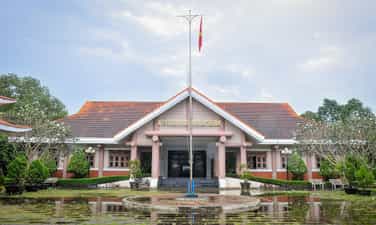
Military Region Committee of Saigon - Gia Dinh
The Saigon - Gia Dinh Party Committee is located in Tan Phu Tay commune, Mo Cay Bac district, Ben Tre province, also codenamed T4, Y4, and is the headquarters commanding the resistance war against the US in the Saigon urban area. Gon - Gia Dinh from July 1969 to October 1970. 50 years ago, in July 1969, the Saigon - Gia Dinh Party Committee was led by comrade Vo Van Kiet and comrades Tran Bach Dang and Mai Chi Tho as Deputy Secretaries, divided into many ministries. small unit, in many secret forms moved to the base of Tan Phu Tay commune. Although the time spent here was not long, the Saigon - Gia Dinh Party Committee Base left behind memorable historical milestones, it was the workplace of Party leaders. Based on the Saigon - Gia Dinh Party Committee, historical documents are still preserved and introduced by the province at the national revolutionary historical relic of the same name, located in Tan Phu Tay commune, Mo Cay Bac district. , Ben Tre province. This is one of the historical sites that attracts a large number of tourists from inside and outside the province every year. The Saigon - Gia Dinh Party Committee base was transferred to be stationed in Tan Phu Tay and Thanh An communes at the time as stated. This is a newly liberated area, the people are resilient, have a high level of political enlightenment, the terrain is very dangerous, many canals divide, there are many consecutive coconut gardens to protect, the enemy cannot land troops by vehicle. Mechanized vehicles, armored vehicles, and even the use of helicopters to land troops are also subject to many restrictions. With only rudimentary materials, mainly using things available on site, local guerrillas built 16 floating bunkers and 14 secret bunkers (distributed in two continuous communes: Tan Phu Tay and Thanh Thanh). An), all are closely arranged so that they can support each other when needed. The floating tunnels are the living, working, and meeting places of the leaders of the Regional Party Committee, the health committee, and the cipher radio department; In addition, there is also a bunker named "happy house", which is the place to stay on the wedding night of Y4 soldiers. By October 1970, the enemy discovered the leaders of the Regional Party Committee operating in Tan Phu Tay commune. They repeatedly sent troops to raid this place and neighboring communes. Faced with that situation, comrade Vo Van Kiet met with the leaders of the Zone Party Committee and decided to withdraw from the base area. While stationed at the base, the leaders of the Saigon - Gia Dinh Party Committee received the loving support of the army and people throughout the district. After the war, the base area was almost completely destroyed. To remember that event, in November 1997, the Party Committee and people of the province restored two bunkers: bunker No. 1 was the meeting place for the basic radio station and bunker No. 2 was the living and working place of the community. Vo Van Kiet and then expanded about 2 hectares to build a number of additional items. The relic was recognized by the Ministry of Culture and Information (now the Ministry of Culture, Sports and Tourism) as a national historical relic on December 23, 1995. Source: Magazine of the Ministry of Labor, War Invalids and Social Affairs
Vinh Long
7473 view
Rating : National monument
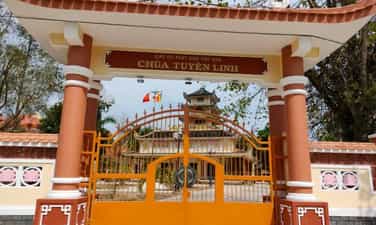
Tuyen Linh Pagoda
Tuyen Linh Pagoda is located in Tan Thoi Dong B hamlet, Minh Duc commune, Mo Cay Nam district, Ben Tre province. Tuyen Linh Pagoda was built in the year of Tan Dau (1861), during the 14th year of Tu Duc's reign. At first, the pagoda was called Tien Linh, led by Venerable Khanh Phong and made of bamboo and leaves to worship Mrs. Sam - who was tiger pounces but very sacred. Tuyen Linh Pagoda is where Mr. Nguyen Sinh Sac, Uncle Ho's father, stopped many times to stay. The longest time Mr. Pho Bang stayed here was from 1927 to 1929. During his stay at the pagoda, Mr. Pho Bang opened teaching classes, checked pulses and made medicine for people in the area, and discussed matters with the Abbot. people, country affairs. In the years before Dong Khoi, Ben Tre was in the harsh grip of America and Diem. The Tan Huong - Minh Duc region, where Tuyen Linh pagoda is located, is still one of the places with the strongest development of the Revolutionary movement in the province. . The agencies of Mo Cay District Party Committee and Ben Tre Provincial Party Committee were once stationed at Tuyen Linh Pagoda with the help and concealment of the people and Buddhist followers during the Revolutionary period. During the two resistance wars, Tuyen Linh pagoda was a place to hide and nurture revolutionary cadres, so twice the enemy used planes to bomb, destroy and burn the pagoda. The pagoda was restored many times and was newly built in 1999 on the old, very spacious foundation. However, there are not many artifacts associated with the pagoda's past. In 1941 the Pagoda was repaired for the first time, and in 1983 the Pagoda continued to be repaired and expanded. In 1999, the pagoda was greatly restored on the old pagoda's foundation. The pagoda has a 0.7m high dharma guardian statue made of ancient bronze. The pagoda garden has stupas inscribed with the names of three Patriarchs: Venerable Khanh Phong (1823-1905), Zen Master Minh Bao (1846-1919) and Dharma Master Khanh Hoa (1877-1948). In 2003, the pagoda received a giant bell that was 1.7m tall and weighed over 330kg. On July 20, 1994, the Ministry of Culture and Information recognized Tuyen Linh Pagoda as a National Historical and Cultural Monument. Source: Compilation of Ben Tre province newspaper
Vinh Long
5092 view
Rating : National monument
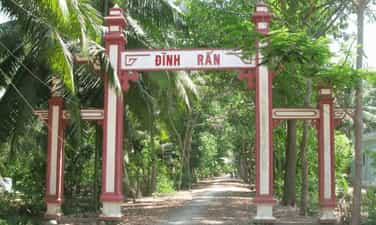
Ben Tre Snake Temple
Snake Temple in Mo Cay, Ben Tre has long been a sacred place, because this place is associated with many legends about the snake god protecting people. Not only that, Dinh Ran is also the place where Hero of the Armed Forces Nguyen Thi Dinh - aka female general Ba Dinh - started the Dong Khoi movement. There is an anecdote that said that when Ms. Ba Dinh was pointed out by Viet traitors, it was the snake god in Dinh Ran who "protected" Ms. Ba, helping her escape from the enemy's vicious gun barrels... Snake Communal House, also known as Dinh Nhon Communal House, is located in Dinh Thuy commune, Mo Cay district, now Mo Cay Nam, Ben Tre province. Snake Communal House is located on a small, isolated road, with spindly eucalyptus trees planted on both sides of the road. According to the people here, in the early 18th century, the four families Nguyen, Phan, Trinh, and Vo were considered the ones who explored this land. This place used to be deserted, with few people and many wild animals. So, when they arrived in this land, the elders built a small temple to worship Mr. Ho. Not long after the temple was established, more and more residents in the area came to admire and worship. The village elders here recently asked to establish a village and named it Dinh Phuoc village. The small temple was built into Snake Communal House. It is called Snake Communal House because in the past there were many high mounds here where many snakes lived. Every time the day comes to worship the temple, the snake appears and disappears for a moment. The offering is left behind after the offering, then the snake comes and takes it away. Since then, the lives of people in the area have become better, crops have always been bountiful, and villagers have been healthy. In the past, in front of the communal house gate, there was a pair of big snakes. That pair of snakes did not harm the people in the area but only ate the meat of beasts, lobsters, and leopards. People in the area call it "Mr. and Mrs. Snake". After the day of national unification, that pair of snakes was no longer seen. In early 1960, Mrs. Nguyen Thi Dinh, known to coconut people as Ms. Ba Dinh, secretly together with the leaders of the Ben Tre Provincial Party Committee, went to Snake communal house to have a meeting to discuss Dong Khoi day. The news leaked out and reached the ears of the Republic of Vietnam regime. The Ngo family immediately sent an army led by a security lieutenant to ambush the Snake temple to capture the revolutionary soldiers. Many soldiers were afraid of the "Snake God" and did not dare to go. A bit confused, the Lieutenant carried a lot of grenades with him so that when he encountered the giant "Mr. and Mrs. Snake" he would blow them up. "My soul is broken", when I was almost able to capture Ms. Ba Dinh, suddenly a soldier screamed wildly, thinking he had seen "Mr. and Mrs. Snake". The soldier pulled out the grenade pin, intending to throw it to "Mr. and Mrs. Snake", but for some reason, he threw it back at his comrades. The soldiers were excited that the other soldier must have been possessed by the "Snake God". The Lieutenant Commander was also seriously injured and a few days later was bitten by a poisonous snake and died. Puppet soldiers attempted to sabotage Snake communal house. But because they were afraid to go near the communal house, they used bombs and grenades to destroy the sacred communal house. Although desolate and dilapidated, Snake Communal House is still a sacred land that surrounded revolutionary soldiers during the years of bloody and horrifying resistance. In 1993, the Ministry of Culture and Information recognized Snake communal house as a national historical and cultural relic. Source: Compilation of People's Electronic Newspaper
Vinh Long
9353 view
Rating : National monument
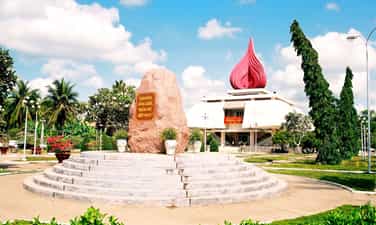
Dong Khoi Ben Tre Special National Monument
Dong Khoi Ben Tre relic belongs to Dinh Thuy commune, Mo Cay Nam district, Ben Tre province. The place where the historical event Dong Khoi Ben Tre took place, opening the Dong Khoi movement of the South Vietnamese revolution. In May 1959, the Party Central Committee held its 15th Conference to review the domestic situation and set out revolutionary guidelines for the whole country and the South, determining the basic task: Liberation of the South from imperialist rule, achieving national independence and the plowmen having their own fields, completing the people's national democratic revolution in the South, moving towards building a peaceful, unified, independent Vietnam. democracy and prosperity. In early December 1959, comrade Nguyen Thi Dinh - Deputy Secretary of the Ben Tre Provincial Party Committee held a meeting at Cu Lao Minh, the Ben Tre Provincial Party Committee selected 3 communes Dinh Thuy, Phuoc Hiep and Binh Khanh in Mo Cay district (now is Mo Cay Nam district) as the guiding base and the starting place of Dong Khoi. At 11:00 a.m. on January 12, 1960, in Dinh Thuy commune, all the people rose up and attacked the enemy. Opening the movement, on the morning of January 17, 1960, revolutionary forces arrested and executed Doi Ty - commander of the General Civil Guard, notorious for his cruelty. Next, the revolutionary forces and the masses surrounded Snake Communal House - where the Civil Guard General was stationed and surrounded and occupied Vam Nuoc station. Our forces captured the station and took control of the situation. Our troops captured 15 guns, 10 grenades and 1,000 bullets of all kinds, liberating all communes and hamlets in Dinh Thuy, puppets and soldiers in the area. rumors of disbandment. At 10:00 p.m. on January 17, 1960, when ordered to rebel, the people of Phuoc Hiep took to the streets to demonstrate their strength to support action groups besieging the civil guard station and the commune. Phuoc Hiep was engulfed in cheers, drums and the continuous explosion of pipes and loudspeakers calling for surrender. The people of Phuoc Hiep commune smashed the enemy's stranglehold, gaining mastery over the entire commune. On January 18, 1960, the people of Binh Khanh commune simultaneously stood up to defeat the hamlets, commune guards, spies and informers, and seized power. Because the puppet forces here were very strong, it was not until 12:00 midnight on January 20, 1960 that Binh Khanh commune was completely liberated. Following the direction of the province, people throughout Mo Cay district simultaneously rebelled, day and night; The continuous sound of drums and gongs spread throughout Cu Lao Minh and Cu Lao Bao. Young men and women were organized into teams, hoisting flags, carrying large guns and small guns with coconut palms, and dragging them like water bursting its banks to demonstrate revolutionary spirit, intimidate the enemy's spirit, making them lie down in fear. stay in the garrison. From Ben Tre, the Dong Khoi movement quickly spread throughout the Mekong Delta provinces. On the night of January 24 and early morning of January 25, 1960, many rural areas rose up to destroy evil, break the grip, disband communes and hamlets, and gain mastery. Until mid-1960, the Dong Khoi fire continued to spread to the Central Highlands provinces, creating a vibrant chain uprising throughout the Southern and Central Highlands provinces. Dong Khoi Traditional House was built in 2001, with a total area of 5,029.3m2, including main items: reception house, victory stele and traditional house. The reception house is built of reinforced concrete, has a pink ceramic tile floor, and a red tiled roof. The house has three doors made of iron frames painted gray and covered with glass, the main door facing East, two side doors facing South. The victory stele was built on the right side of the relic, consisting of seven concentric circular steps covered with blue polished stone. The front facing south is engraved with eight golden words "Heroes rise together, defeat the Americans and destroy the puppets". The back of the stele is engraved with the content "Miracle Fire" because Ben Tre province launched a contest to write an epitaph praising Dong Khoi in 1960, and was engraved on the stele to commemorate the 45th anniversary of Dong Khoi Ben Tre. The Traditional House has a ground floor and an upper floor, on the roof is a 12m high Dong Khoi torch symbol. The inside of the ground floor displays images, documents and artifacts of the political struggle movement of the people of Ben Tre from July 1954 to the end of 1959. The upper floor displays images, documents and artifacts from the Ben Tre people's political struggle. Dong Khoi movement. In the middle hall, there is a stylized wall embossed with the words "Heroes rise together, defeat the Americans and destroy the puppets", next to it is a sand table representing the Dong Khoi Ben Tre movement. Dong Khoi Ben Tre relic was ranked by the Prime Minister as a special national relic on December 22, 2016. Source: Department of Cultural Heritage
Vinh Long
9656 view
Rating : Special national monument
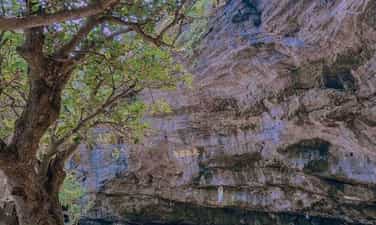
Quang Ngai Cave Pagoda
Hang Pagoda (Thien Khong Thach Pagoda) also has the folk name "Kong Khong Pagoda" located northeast of Re Island (Lon Island) in An Hai commune, Ly Son island district. The unique architecture of Hang Pagoda was not built by human hands but by the magic of creation. Not built of wood, bricks, lime, or mortar, Hang Pagoda is simply a stone cave deep into the foot of Thoi Loi mountain (Ly Son district, Quang Ngai province). Hang Pagoda is the largest natural cave in the cave system in Ly Son, formed during the seaward period, about 4,500 years ago. From the wave marks around the foot of Thoi Loi mountain, rising significantly above the current tide level, especially the rocks in front of Hang Pagoda are vivid evidence of the phenomenon of ocean waves eroding into fine-grained sediment layers. , rocks and carbonate mud. The notes of French archaeologist Parmentier, oral tradition and a few remaining traces show that Hang Pagoda was originally a stone cave that the Cham people used as a place of residence or worship. before the Vietnamese set foot on Ly Son island. The genealogies and legacies of the first families to explore An Hai village show that about 4 centuries ago, during the reign of King Le Kinh Tong, Mr. Tran Cong Thanh and the ancestors of An Hai village were the initiators of this work. renovated and expanded the cave, turning this place into a Buddhist temple. Later, descendants of the Tran family added the spiritual relics of the Zen sages of Ly Hai village to the pagoda to worship. According to the genealogy of the Tran family, the family that oversees Hang Pagoda, this pagoda is about 300 years old. During the time when pirates (Tau O invaders) were harassing, Hang Pagoda was a safe hiding place for people. Inside the pagoda is a cave 24m deep, 20m wide, 3.2m high, and there are many nooks and crannies. Legend has it that in the past, this was the road to the underworld. According to the concept of good and evil going hand in hand, the main space of Hang Pagoda is for the good and those who know how to repent. On the contrary, if the guilty person refuses to turn back, they will be banished to the underworld in a smaller cave next door. Before there was a concrete road running to the top of the slope down to the pagoda, to get to the pagoda, one had to follow the difficult mountainside. The part of the mountainside facing the sea is called the meow, and is where many unfortunate people slip and fall onto the rocks and are injured or even lose their lives. From the foot of Thoi Loi mountain in the Southeast, around the mountain ridge in the Northwest, then following the stone steps down gradually, closer to sea level, visitors will see rows of banyan trees towering in front of the pagoda yard. (square almond tree) is hundreds of years old. Looking up is the windy ocean, looking back is the "heavenly rock cave", looming in the distance is Bo Bai island. In front of the majestic stone pagoda is a full-body statue of Avalokiteśvara Bodhisattva with benevolent eyes facing the ocean as if containing sympathy for sentient beings. Lightly step into the temple, which is also a stone cave, amidst the faint smell of incense, a dim candle shines into the gloomy light and darkness, it takes a moment to calm down, eyes get used to the darkness, to recognize to the altar to worship Tam The Buddha, Amitabha Tam Ton, Hoa Nghiem Tam Thanh and the bodhisattvas, patriarchs, and sages who publicly destroyed An Hai village and Ly Son district. Like all other Buddhist temples, the largest number of people coming to worship and pray to Buddha at Hang Pagoda is on the occasion of Lunar New Year, Nguyen Tieu, Buddha's Birthday, Vu Lan and the days of worshiping, wishing, worshiping Buddha, Bodhisattva... Especially In particular, Ly Son fishermen, whether they are Buddhists or not, come here to worship very solemnly and seriously on Bodhisattva Avalokiteśvara days or before entering the fishing season (sea gate opening). . Source: Vietnam National Tourism Administration
Quang Ngai
6150 view
Rating : National monument
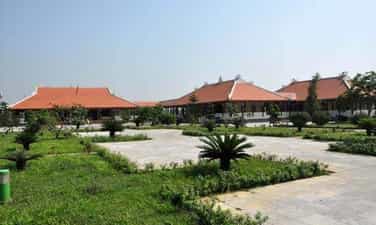
Memorial house of late Prime Minister Pham Van Dong
Memorial area of Prime Minister Pham Van Dong in Duc Tan commune, Mo Duc district, Quang Ngai. Where many high-ranking delegations from the Party and state, from Quang Ngai province and the people of the country, international friends come to commemorate and learn about Prime Minister Pham Van Dong. Prime Minister Pham Van Dong was born in Thi Pho Nhat village. Since 1925, he participated in the student movement fighting for the French to release Phan Boi Chau, and mourned Phan Chau Trinh. In 1926, he participated in a training course organized by Nguyen Ai Quoc and was admitted to the Vietnam Revolutionary Youth Association. From then on, young man Pham Van Dong embarked on the revolutionary path. The August Revolution was successful and he held the position of Minister of Finance. During the years of resistance against the French, he was a representative of the Party Central Committee and the Government in the South Central region. In 1949, he was appointed Deputy Prime Minister and from September 1954 also served as Foreign Minister and Head of the Central Foreign Affairs Commission. Then from September 1955 to December 1986, he held the position of Prime Minister. Tourists often stop for a long time at the artifacts of the late Prime Minister's daily life. A bike. One suitcase. Coffee box containing rice. Mr. Nguyen Tan Van, Former Vice Chairman of the People's Council of Mo Duc district, Quang Ngai province shared his thoughts: I visited the souvenir area many times, stopped for a long time at the bicycle and the rice cart with 4 food boxes when going. work and was touched by Uncle Ho's simplicity. Prime Minister Pham Van Dong always mingles with the people, sticks with the people, shoulders the burden, and leads the Vietnamese revolution through extremely difficult historical periods. In every position and responsibility, the Prime Minister has completed his duties excellently. During the years of resistance against the French, as a representative of the Party Central Committee and the Government, Pham Van Dong, along with martyrs Huynh Thuc Khang and Nguyen Duy Trinh, directed the fight against the French to maintain the freedom zone of Inter-Region 5. Especially , an extremely astute person in foreign affairs, was the head of the delegation of the Government of the Democratic Republic of Vietnam to the Fontainebleau Conference in France in 1946, and the head of the delegation to the Geneva conference in 1954. Although, busy Busy with national and people's affairs, Prime Minister Pham Van Dong always cares about the young generation and the country's education cause. Educate and cherish the future generations of the country and the nation. During 75 years of revolutionary activities, 41 years as a member of the Party Central Committee, 35 years as a member of the Politburo, 32 years as Prime Minister, 10 years as Advisor to the Party Central Committee, Prime Minister Pham Van Dong has made many great contributions. Prime Minister Pham Van Dong's life is a life of commitment to the revolutionary cause of the Party and the nation. The 115th birthday anniversary of Prime Minister Pham Van Dong is another time to remember and pay tribute to the contributions of the Prime Minister who always lives in the hearts of the people. Source: Quang Ngai province website
Quang Ngai
9118 view
Rating : National monument
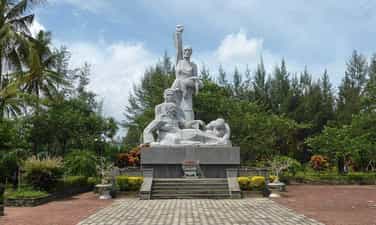
Son My relic site
Son My relic site, located next to Highway 24B, belongs to Tu Cung village, Tinh Khe commune, Son Tinh district, Quang Ngai province. This is a place to preserve evidence of the scene, as well as a place to display images, artifacts and place a monument commemorating the 504 victims of the Son My massacre, also known as the My Lai massacre. Son My is the name the Saigon government gave to Tinh Khe commune, while My Lai is the spelling in military documents and maps, and later in the American press, to designate Tinh Khe commune. This name originates from the name of My Lai village, one of the four villages (hamlets) of Son My. Pinkville (Pink Village) is also another name for Son My used by the US military as a nickname in combat maps. The Son My massacre occurred on March 16, 1968, on February 18, Mau Than year, according to the lunar calendar. The main unit that caused the bloody event that shocked world public opinion was the 1st platoon, 11th brigade, Army division, American expeditionary force. On that "terrible morning", after heavy rounds of artillery shelling the village, American troops landed by helicopter on the fields west of Tu Cung hamlet and Go hamlet (Co Luy hamlet) in Tinh Khe commune. The insanely brutal and destructive massacre began with American soldiers hunting down and shooting civilians. Houses and shelters were destroyed, burned, and cattle were shot and killed. The climax of the brutality was the gathering of villagers, mostly old people, women and children, into groups and then shooting and killing. 102 people were killed at Watchtower, 170 others were shot in a ditch east of Thuan Yen hamlet, Tu Cung hamlet. American soldiers did not encounter any reaction from the "enemy" side, other than the screams of panic and pain from innocent victims. Their only loss in personnel was when black soldier Herbert Carter shot himself in the leg to avoid participating in the massacre of his fellow men. Horrifying truth:. In just one morning, 504 innocent civilians were killed (407 people in Tu Cung village, 97 people in My Hoi village), including 182 women, 173 children, and 60 elderly people. There were 24 families killed, 247 houses burned down. Immediately after the massacre, the National Liberation Front Committee at all levels and the Government of the Democratic Republic of Vietnam spoke out to denounce the crimes of the American expeditionary force before domestic and foreign public opinion. However, it was not until a year and a half later that this horrifying event was revealed in America by American journalists and veterans. Americans and the whole world were shocked. The movement opposing America's involvement in Vietnam spread widely. Many prestigious figures, intellectuals, and social activists in the US and many parts of the world demand that leading figures in the White House and the Pentagon be put on trial for war crimes. After the liberation of the South, the revolutionary government protected the remaining evidence after the massacre, built a memorial for the victims and a house displaying pictures and artifacts related to the Son My massacre. In Thuan Yen hamlet, Tu Cung hamlet, next to the water canal that was once red with the blood of 107 victims who were collectively murdered. After many restorations, the evidence area now has an area of 2.4 hectares, including two main areas: the field evidence area (west) that has been preserved and restored and the additional exhibition area and statues. memorial, reception house (east). In addition, there are relics related to the massacre in Tu Cung village and My Lai village. There are documentary films recording the stories and images of survivors, and many scrapbooks that visitors have written in in many languages, truly expressing the feelings and attitudes of many people. people, of many generations, many different religions, ethnicities and political trends, when learning firsthand about the Son My massacre. Source: Quang Ngai Electronic Newspaper
Quang Ngai
8838 view
Rating : National monument

Mo Cay Victory Monument
Mo Cay Victory Site Relic located in village 1, Duc Chanh commune, Mo Duc district, Quang Ngai province Immediately after the Ba To uprising, from March 1945 to May 1945, the Provincial Party Committee decided to move the Ba To guerrilla team to operate in the Co Nhat area of the Cao Muon mountainous region (Ba To district), building Anti-Japanese war zones in Nuoc Sung and Nuoc La areas (Ba Vinh commune, Ba To district) and propagating and mobilizing local ethnic people to stand up to expel the Japanese fascists and their henchmen. From 28 soldiers trained in Nuoc Sung and Nuoc La, the Ba To guerrilla team quickly developed its force, moved to the delta to build a base in Vinh Son base area (Tinh Hiep commune, Son district). Tinh) and Nui Lon base area (Duc Lan commune, Mo Duc district), forming two revolutionary armed companies named Phan Dinh Phung and Hoang Hoa Tham. Phan Dinh Phung Company led by comrade Pham Kiet as Company Commander, comrades Phan Phong and Vo Thu as Vice Captains, comrade Ta Phuong as Political Commissioner, was staffed into 5 platoons: Am Loan, Bo Khiet, Phong Phong, Cao Thang, Tu Trong and Tu Nhai. Each Platoon has 5 squads, each squad has 12 people. Hoang Hoa Tham Company also has 5 platoons: Nguyen Nghiem, Cu Dinh, Pham Hong Thai, Ngo Dang and Tan Tu, the staff is the same as Phan Dinh Phung Company, with comrade Nguyen Don as Company Commander and Politician. member, then comrade Tran Cong Khanh returned as Company Commander to replace comrade Nguyen Don, comrades Nguyen Khoach (Thanh) and Le Van Duc as Deputy Company Commanders, comrade Nguyen Cu (Nhan) as Deputy Political Committee pellets. While the Ba To Guerrilla Team rapidly developed into the core armed force for the pre-uprising climax in Quang Ngai, on August 14, 1945, Japan surrendered to the Allies. The time has come, although we have not received the order for a general uprising from the Central Government, but after grasping the situation, at exactly 4:00 p.m. on August 14, 1945, from Thi Pho and Mo Duc, the Provincial Party Committee ordered a general uprising to seize power. throughout the province. Complying with the General Uprising order of the Provincial Party Committee and according to the agreed plan, Phan Dinh Phung Company from Vinh Son war zone launched a sortie to capture the posts of Di Lang, Ha Thanh, Tra Bong and the guard post of Chau O bridge, Then he pulled his troops back to stand at Xuan Pho, west of Quang Ngai town, waiting for orders. Hoang Hoa Tham Company from the Nui Lon war zone quickly marched to capture the posts of Ba To, Minh Long, Nghia Hanh, Mo Duc, Duc Pho, then advanced to the Lam Dien (Mo Duc) station area, then Deploying an ambush formation to attack the Japanese in Mo Cay On the morning of August 17, 1945, the unit of comrades Nguyen Hoa and Nguyen Khai arrived at Lam Dien station, after destroying the railway, digging a tunnel to wait for the Japanese to arrive, but no Japanese soldiers arrived. The comrades turned to Highway 1A and arranged an ambush at Thi Pho. When we saw a Japanese military vehicle appear, we suddenly opened fire and killed 5 people. The Japanese soldiers panicked and drove away. We recovered a Japanese Sten submachine gun and 75 bullets. After that, the unit continued to march to Mo Cay, implementing a plan to ambush the Japanese convoy from the south to pull the vehicle to Quang Ngai town. At 4:00 p.m. the same day, the Provisional Revolutionary Committee of Hoai An and An Phong communes (now part of Duc Chanh commune) organized red self-defense teams and people to dig roads and destroy sewers to create obstacles to hinder the group. Japanese military vehicles travel on Highway 1A to block the march of Japanese troops from the south toward the town. The victory of the Mo Cay Battle of the Ba To Guerrilla Team left behind a lot of valuable experience in flexibly applying ambush tactics to attack the enemy on National Highway 1A, achieving high combat efficiency and destroying many vital forces. enemy. This lesson was applied in the resistance war against America to save the country. Here, on June 7, 1966, Battalion 48, the provincial armed forces heroically blocked and attacked Battalion 3, belonging to Regiment 4, destroying 408 people, including 2 Americans, setting fire to and destroying 18 vehicles. 267 guns of all kinds. From here, Mo Cay became a place marking the victory against the Japanese and American puppets in the struggle for national liberation. Source: Collection of Quang Ngai Provincial Museum
Quang Ngai
5923 view
Rating : National monument