Tourist destination
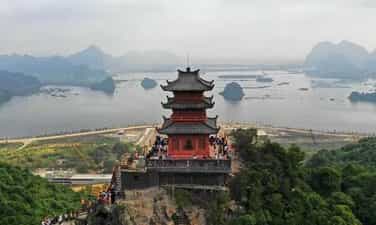
Perfume Pagoda.
Perfume Pagoda is located in Huong Son commune, My Duc district, about 50km from Hanoi city center. This place is known as one of the most unique spiritual destinations in Hanoi! Huong Pagoda is also the center of a cultural and religious complex consisting of many other ancient and sacred temples and pagodas. Destinations at Huong Pagoda: Trinh Temple It's the first temple you come to after getting off the boat. Built at the foot of Ngu Nhac mountain, majestic and wild. Thien Tru Pagoda The pagoda is located on the terrace of Lao mountain, built and completed in 1467. It takes about 40 minutes to walk from the ferry wharf to Thien Tru pagoda. Giai Oan Pagoda The pagoda is located on the road to Huong Tich cave, about 2.5km away on Long Tuyen mountain, with an ancient and nostalgic look. Suoi Yen This is the only waterway to get to Huong Pagoda, about 4km long. Huong Tich Cave The cave is shaped like a dragon opening its mouth to play with pearls. Huong Tich Cave is at an altitude of 390m, you can climb or travel by cable car. Thanh Son Pagoda The pagoda has both river and mountain entrances with majestic natural scenery. Thanh Son Pagoda is one of the temples that represents Vietnamese beliefs. Long Van Cave From Long Van wharf, climb about 150m to reach Long Van pagoda, go through the mountain to Long Van cave. Long Van Cave has an airy and spacious space. Sung Sam Cave Sung Sam Cave is at an altitude of 100m, the door faces southwest and the cave is about 15m wide. Bao Dai Pagoda The pagoda is located at the foot of the mountain and currently has the architectural style of the Nguyen Dynasty. Tuyet Son Cave The cave is located in the middle of the mountain, the road to the cave is relatively easy. Inside there are countless stalactites with strange and beautiful shapes.
Hanoi
5454 view


Vietnam Museum of Ethnology
The Vietnam Museum of Ethnology has many functions: researching, collecting, preserving, and restoring artifacts and documents about ethnic groups; Organize exhibitions, performances and other forms of activities to introduce and educate about the culture of ethnic groups in Vietnam as well as other countries... Located right on Nguyen Van Huyen street, Cau Giay district, Hanoi, the Vietnam Museum of Ethnology is only about 8 km from the center of Hanoi capital, very easy for you to get around. For the people of Hanoi in particular and the people of Vietnam in general, the museum has enormous cultural meaning and value. On your journey to explore Hanoi's old quarter, you definitely cannot miss this place. Vietnam Museum of Ethnology was built in 1981 with an initial area of 3.27 hectares. After many renovations, the museum area was increased to a total area of 4.4 hectares. This is a project designed by architect Ha Duc Linh, a Tay person; The interior was designed by female architect Véronique Dollfus (French). With the purpose of preserving the history and culture of 54 Vietnamese ethnic groups, the museum is one of the attractions in Hanoi suitable for students and tourists interested in learning about everything. the cultural features of each nation. Artifacts are displayed in many different categories such as costumes, jewelry, weapons, musical instruments, religion, houses... and are loved and highly appreciated by visitors.
Hanoi
5656 view


Thanh Chuong Viet Palace
Viet Phu Thanh Chuong was built in 2001, originating from the idea of artist Thanh Chuong - who wanted to recreate the cultural imprint of his ancestors in ancient times. Located on a plot of land with an area of more than 8,000 hectares in Soc Son, Viet Phu Thanh Chuong is considered a massive architectural work with bold Vietnamese characteristics. Viet Phu Thanh Chuong is located at Keo Ca lake, Hien Linh commune, Soc Son district, only about 40km from Hanoi center so moving here is relatively easy. You can choose from many types of vehicles such as cars, motorbikes, buses... Viet Phu Thanh Chuong encompasses 30 architectural works bearing the appearance of Vietnamese history of the last century. Walking around a large circle, visitors will feel the historical space rushing back into their memories. First, you will admire the beauty of 13 ancient houses with special names such as Tuong Van house, Thanh Tinh house, Huong gate, Mac Huong house, Xuan Phong restaurant,...
Hanoi
4709 view


An Hien garden house
Located on a land area of nearly 6,500 square meters, An Hien garden house is designed exemplary according to Hue garden house architecture, influenced by feng shui, architecture and nature blend together: in front there is the romantic Perfume River. , through the gate is a long walkway, followed by a screen, turning into a path with a yard, flower beds, ornamental plants and a clear blue lake and then to the majestic old house, modestly hidden in the middle of a spacious garden. The garden gate is built in an ancient arch shape. In the middle of the gate, on the outside, under the roof is an embossed horizontal scroll, a sign with the two Chinese characters "An Hien" inlaid with blue and white porcelain on a black wall background. From the main gate, following the long dirt road, you will see a large screen bending slightly to the west, protecting the main church. Behind the screen is a small lake planted with water lilies, located in front of the main church yard. The main architecture is a house with 3 rooms and 2 wings located almost in the center of the garden. The house is 135m2 wide, has exemplary architecture of traditional architecture in general and is one of the typical ancient houses that clearly demonstrate the traditional building art of Hue under the Nguyen Dynasty. The interior space of the house is clearly divided according to use function. The middle space is the worship space, with the principle of "before Buddha, then after Spirit". In particular, the house has many precious memorabilia of the Nguyen Dynasty royal court. In the middle space, above the first row of columns, hang two scroll-style horizontal scrolls, the first one is titled "In the district district" (meaning "The court uses it"), the second one is a scroll with gilded leaves and flowers titled "Van and Martial Arts". "filial piety" given by King Bao Dai to his family in the year of the Suu (1937) along with many poems by King Thanh Thai, are now also hung in the reception area of the house. Later, due to the need to receive guests as well as make the house a place to visit, Mrs. Tuan Chi built another house with French-style architecture on the left side of the neighboring Ruong house for living and activities. A special feature of this new house is Ms. Tuan Chi's book library with 338 books in many diverse genres such as literature, history, politics, law, dictionaries, feng shui... written in many languages. such as Vietnamese, French, English, Russian, Japanese. Not only is it a special house that has preserved many generations of famous families, An Hien is also truly an ecological space, a garden of four-season scents. Many rows of trees and tree stumps here are more than a hundred years old. Many types of fruit trees and rare tree varieties from all 3 regions are also brought here to gather. In particular, the great-grandson of the great poet Nguyen Du gave Ms. Tuan Chi 14 Tien Dien persimmon trees, which were presented to the king on the occasion of Thuong Tien festival. In particular, in the garden there are many Giang Chau mangosteen trees, a famous precious fruit in Hue that is used to honor the king... Hue not only attracts tourists because of the beauty of the natural landscape or the attraction of the specialty dishes but also because of the relics that preserve a long-standing culture. In the middle of the bustling city, An Hien garden house with its ancient architecture is always a famous tourist destination you cannot miss when you have the opportunity to come to this capital!
Hue
5313 view


Truong Tien Bridge
Trang Tien Hue Bridge is considered a symbol of the ancient capital, bearing a strong historical mark through many ups and downs of the country. This is also an attractive tourist destination that attracts all tourists when coming to Hue because of its charming and poetic beauty spanning the slowly flowing Perfume River. Crossing the gentle Perfume River, Trang Tien Hue Bridge is not simply a not only a traffic project but also a witness to history that has existed for more than a century with many changes. This is also a check-in point that attracts many tourists when traveling to Hue because of its charming, poetic and ancient beauty. Trang Tien Bridge Hue is located right in the city center and is also known as Truong Tien Bridge , Thanh Thai bridge. The bridge connects the two banks of the Huong River with the northern end belonging to Phu Hoa ward, the southern end belonging to Phu Hoi ward. This is the first bridge in the Indochina region built using techniques and materials imported from the West. The bridge is built of steel with a total length of more than 400 meters, including 6 spans of steel girders in the shape of a rim, each span is 67 meters. Trang Tien Hue Bridge has entered poetry and become a symbol and attractive destination. The ancient capital is guided by its historical values and unique beauties as follows: Trang Tien Bridge is a witness, a beautiful historical relic over time: With more than a century of age, Trang Tien Bridge in Hue has gone through many ups and downs of history in the land of the ancient capital. With advanced and modern construction techniques, the bridge has been the pride of the people of Hue since its completion. The bridge went through the resistance war against the French with heavy destruction and many restorations and repairs. Check-in Trang Tien Hue: Trang Tien Bridge possesses a very unique and impressive ancient, peaceful beauty. This is the beautiful background in virtual live photos. So, during your trip to Hue city, don't miss the opportunity to walk on the bridge and take many beautiful photos. Enjoy the panoramic view of Hue during the day: The image of the graceful bridge reflecting on the peaceful Perfume River and the boats quietly crossing the river is the beautiful scene that you can witness when coming here. The bridge also makes visitors fall in love with its simplicity and indescribable gentle beauty. Visit and admire the sparkling Trang Tien Bridge at night: In 2002, besides the existing lighting system, Trang Tien Bridge was also installed with a modern color-changing light system. Thanks to that, it's like wearing a new, sparkling, magical shirt every night. This is also a great time for you to visit, admire Truong Tien Bridge and enjoy the cool, fresh air. You can also admire the Perfume River flowing slowly and listen to Hue ca tru songs echoing from dragon boats. Take a walk in the walking street right under the bridge: The bustling walking street and night market right under the bridge are also places that bring you many interesting experiences. This place possesses a simple beauty and a bustling atmosphere with many souvenir stalls and delicious specialty restaurants. So, after the scenic journey and strolling on the bridge, stop by the walking street to enjoy delicious food and conveniently buy gifts for relatives and friends.
Hue
5183 view


Co Loa Citadel
Co Loa Citadel was the capital of the Au Lac state under King An Duong around the 3rd century BC and of the feudal state under Ngo Quyen in the 10th century in Co Loa commune, Dong Anh district, Hanoi. Noi. Co Loa today is not only a cultural heritage, a proof of the creativity, technical and cultural level of the ancient Vietnamese people, but also an ideal destination for tourists from all over. Co Loa Citadel is not only associated with the legends of the Vietnamese people, such as King An Duong Vuong establishing the capital and building the citadel, the Kim Quy magic crossbow shooting down hundreds of invaders in one shot or the tragic and touching love story of My Chau - Trong Thuy..., but also a unique tourist attraction of Hanoi Capital. Known as the largest ancient citadel in Vietnam, Co Loa historical site is about 500 hectares wide, built by King Thuc An Duong Vuong in the 3rd century BC to be the capital of Au Lac (the name of Vietnam during the period). that), now belongs to Dong Anh district, a suburb of Hanoi. Legend has it that the citadel has nine spiral-shaped rings, so the people of the ancient citadel also called it Snail citadel. Due to the destruction of time and war, the citadel currently has only three rings left with ancient vestiges, which are the inner citadel, the loyal citadel and the outer citadel. The outer citadel has a circumference of about 8km, built by the method of excavating the soil wherever you go, digging trenches there, building ramparts, and building adjacent ramparts. The ancient ramparts were 4-5m high, especially some were 8-12m high. The central citadel has a circumference of about 6.5km, and has the same structure as the outer citadel but the area is narrower and more solid. The inner citadel has an area of about 2km2, and is the residence of King An Duong Vuong and his concubines, beauties and mandarins under the court. Co Loa Citadel has many different names such as Loa Thanh (Snail Citadel), Con Lon Citadel, Tu Long Citadel, Cuu Thanh Citadel, Viet Vuong Citadel, Kha Lu Citadel, and Co Loa Citadel. In the 10th century, when Ngo Quyen was king, Co Loa became the capital for the second time. Today, in the Co Loa relic site, there are still many historical, architectural, and artistic relics preserved, such as the Thuong temple worshiping An Duong Vuong, the temple worshiping General Cao Lo, the temple worshiping Princess My Chau, and Bao Son pagoda... In temples and pagodas, there are also many archaeological artifacts unearthed in the Ancient Citadel such as bronze statues, bronze arrows and delicately carved porcelain and stone items.
Hanoi
6015 view


Bat Trang Pottery Village
Bat Trang Pottery Village - a village famous for traditional pottery is located about 13 km southeast of Hanoi center. With more than 700 years of history and continuous development, Bat Trang pottery village has become an attractive destination for those who love ceramic art and want to explore traditional Vietnamese culture. - Ly Dynasty: The pottery factory of Thanh Hoa potters was moved here. - Tran Dynasty: Bat Trang Pottery Village became the largest ceramic manufacturing center in the North. - Le Dynasty: Bat Trang pottery reached its peak of development, producing many types of worship items and sophisticated household items. - Nguyen Dynasty: Bat Trang pottery continued to develop but output was not much. - Currently: Bat Trang pottery village has been restored and developed strongly, becoming an attractive destination for domestic and foreign tourists. The pottery village is located in Bat Trang commune, Gia Lam district, Hanoi city, about 10km from the city center and 40km from Noi Bai airport. Therefore, traveling and visiting the pottery village is not too difficult. To get here, visitors can travel by personal means such as cars, motorbikes or public transport such as buses and trains.
Hanoi
5665 view


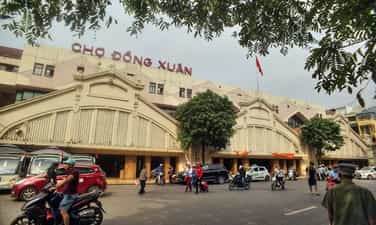
Dong Xuan Market
Dong Xuan Market is one of the largest markets with the most cultural and historical values in Hanoi. Over thousands of years, the market has still developed and has a large number of buyers and sellers trading busily every day. Dong Xuan Hoan Kiem Market in Hanoi is one of the largest markets in the North and is hundreds of years old. Located in the center of the capital, this is not only a bustling place for trade but also a "culinary paradise", a place to "pamper" Hanoi tourists with delicious Hanoi dishes. Dong Xuan Market is located right in the center of Hanoi's Old Quarter, Dong Xuan Ward, Hoan Kiem District. Only about 1km from Hoan Kiem Lake, very close to Long Bien station and Hang Ma street. To the west of the market is Dong Xuan street, to the east is Dong Xuan alley, to the north is Hang Khoai street and to the south is Cau Dong street. Like many other markets, Dong Xuan market is open every day of the week, from 6am - 6pm every day. As for the food court at the market alley, it is open until dawn the next morning. In particular, on weekends Friday, Saturday, and Sunday, Dong Xuan market is open until 10:30 p.m. to serve the sightseeing and shopping needs of tourists. This is one of the crowded and bustling shopping places that tourists cannot miss when traveling to Hanoi. Dong Xuan Market is a large-scale market that has been around for hundreds of years. This place has witnessed many changes in Hanoi over time and is known by another name, Cho Lon. History books record that in 1804, the Nguyen court built a market in the south of To Lich river to facilitate trade by ships. In 1889, after the To Lich River and Thai Cuc Lake were filled, the French government planned and packed the shops into an empty land in Dong Xuan ward. In 1890, the French built the market with a total area of 6,500 m2 according to French architecture with 5 toilets, 5 triangles with honeycomb holes and 5 arches. By 1990, the market was renovated with only 3 middle rows and 3 floors. In 1995, Dong Xuan market was rebuilt with full firefighting, ventilation and escape systems. At that time, the market had an area of up to 14,000 square meters with about 2,000 stalls. This place has become the most modern and busiest market in Hanoi.
Hanoi
6566 view


Bach Ma National Park
Bach Ma National Park is located in Phu Loc district, Thua Thien Hue province, 40km from Hue city, 65km from Da Nang. Bach Ma National Park is part of the Truong Son Bac range, with many mountain ranges with peaks over 1,000m running horizontally from West to East. Bach Ma National Forest has a total area of nearly 37,500 hectares, is a large primeval forest, has 2,373 plant species and 1,715 diverse animal species, including many rare species, listed in the Vietnam Red Book. History of Bach Ma National Park according to local people, Bach Ma National Park was discovered and exploited by a French engineer named M.Girard in 1932, this place became a floating resort. famous since 1945. Experiences not to be missed when coming to Phu Loc National Park, Thua Thien Hue Visit Vong Hai Dai (sea observatory): Vong Hai Dai is located at the majestic Bach Ma peak, at an altitude of about 1,430m above sea level. From Vong Hai Dai, you can easily admire the majestic mountain panorama of Bach Ma national forest, admire Lang Co bay or beautiful Canh Duong beach from afar. To get to Vong Hai Dai, you will need to go through Vong Hai Dai trail. You can choose to go trekking on the trail or choose to travel by car to avoid getting tired. Explore Ngu Ho Bach Ma: To get to Ngu Ho Bach Ma, you walk from Vong Hai Dai down about 2km to Do Quyen villa, continue following the signs to Ngu Ho, discover 5 enchanting lakes. with different beauties. The water at Bach Ma Five Lakes is clear, the lakes all have extremely unique terrain, creating a beautiful scene like a watercolor painting. Check-in for virtual life at Do Quyen waterfall and Tri Sao waterfall: Do Quyen waterfall is a definite destination not to be missed when you travel to Bach Ma Hue national park. To get to Do Quyen waterfall, follow the sign from Ngu Ho Bach Ma, climb to the top of Do Quyen waterfall. The waterfall is called Do Quyen because the Azalea flower grows abundantly on both sides of the waterfall. Do Quyen Waterfall is a waterfall with a height of 300m, churning out white foam, possessing a wonderful natural scenery in Bach Ma Hue National Park. Tri Sao Waterfall is also an attractive virtual check-in spot no less than Do Quyen Waterfall. To get to the waterfall, you will have to climb mountain slopes and go through thin forests to get to the place where you can feel the sound of water flowing through each stone step. , watching the clear, beautiful lake. Experience exploring the black cat forest: Bach Ma Hue National Park has a rich and diverse ecosystem, in which the black cat forest stands out with many majestic ancient trees, straight trunks, pyramidal canopy, and diameter trees. up to more than 1m and over 30m high, growing close together. Visit Truc Lam Bach Ma Zen Monastery Hue: Going to Bach Ma National Park and not visiting Truc Lam Bach Ma Zen Monastery would be a mistake. The monastery is located in the middle of Truoi Lake, on Linh Son mountain. Coming here, you can see the beautiful natural scenery of Truoi Lake, or explore the architectural works of the monastery such as The main hall, the main hall, the monks, the monks... are built in harmony. Bach Ma Hue National Park is an attractive destination that you should experience when traveling to Hue, hopefully with experience traveling to the national park. Join Bach Ma Hue in the article, you will have a complete and perfect trip.
Hue
5545 view


Huong Thuy Xuan Village
Located on Huyen Tran Cong Chua street, about 7km southwest of Hue city, is the largest Perfume village in Hue - Huong Thuy Xuan village, famous for making incense sticks for hundreds of years. Thuy Xuan incense making village is located on the tourist route to visit Tu Duc mausoleum and Vong Canh hill, so it is quite convenient for local people and tourists to know more about the craft village. Tourists who visit Perfume village, explore the process of making incense by hand in the village, enjoy the joy of sewing an incense stick by hand, making an incense stick themselves, as well as learning more about the profession and people. the life of the people of Hue. Incense in Thuy Xuan has a unique aroma and good quality. Most people here work as incense makers and make a living from making incense. The traditional profession of our ancestors is deeply ingrained in the flesh and blood of the people of Thuy Xuan village. They are passionate, love their job, and meticulous about their job from morning to night. They maintain the profession of making incense because their passion for the profession is the main thing, because incense is made by hand, without using a beater, so the productivity is not as high as making a machine, and the price is very affordable, so the profit is only enough to cover meals. During the day, customers who come to buy incense, souvenirs or just to take pictures are all very happy and welcoming with gentle, friendly smiles. As soon as you stepped foot into the village, the fragrance of incense filled the air. To make an incense stick, the first step is to choose ingredients, usually including: Five-spice herbal medicine with cinnamon, cardamom, pine buds, cloves, star anise, eucalyptus, cinnamon... mixed with water, mixed again. together to make incense powder. Next is the step of making the incense core, the incense core is made from bamboo intestines split into small pieces, dried in the sun for many days to dry and crispy. The bamboo used to make the incense core is old bamboo taken from Nam Dong forest, Binh Dien, Phong Son. The incense powder is mixed and then tightened around the incense core, tightened until it is thin and round enough, then dried in the sun. The people of Thuy Xuan village still preserve the traditional way of making incense instead of using an incense machine, although it is quite more difficult, but it is still folk, preserving the tradition and "soul" of the profession. Thuy Xuan incense village supplies the market with all kinds of incense such as: Cinnamon incense, lemongrass oil incense, deodorizing incense, incense sticks, agarwood buds, the most prominent is Agarwood incense, the village's incense does not use chemicals, only Using natural flavors and ingredients that are friendly to the environment and health, the product has a brighter yellow color than other flavors and has a pleasant characteristic scent. Initially, incense was only brown and red, but now visitors will easily see many types of incense with colorful incense bases: purple, yellow, blue, pink... spreading into colorful, shimmering incense flowers. shining in the sun. The colorful space and the enthusiasm and hospitality of the people here have made visitors fascinated, amazed and overwhelmed. Just click the camera, visitors will have sparkling auto images like in a magazine Now people here also combine making incense and making tourism products, selling souvenirs such as oil paintings, fans, and brocade items to earn more income, helping people's lives improve. than. Huong Thuy Xuan not only supplies demand in the province but also throughout the country as well as exporting abroad. Thuy Xuan incense village has become a unique cultural beauty of the ancient capital that has been passed down and developed until now.
Hue
5475 view


