Relic point Vietnam
Việt Nam
Sung Nghiem Dien Thanh Pagoda
Sung Nghiem Dien Thanh Pagoda is an ancient pagoda that dates back to before the Ly Dynasty and is classified as a national monument; The pagoda is located in Duy Tinh village, Van Loc commune, Hau Loc district, Thanh Hoa province. The pagoda is also a place to worship General Tran Hung Dao. Van Loc commune, Hau Loc district was formerly the headquarters of Cuu Chan district for nearly 400 years (during the Ly and Tran dynasties). Lieutenant Ly Thuong Kiet has been here for 19 years. The dictionary of Vietnamese cultural relics, Science & Society Publishing House (page 582) records about the pagoda as follows: "The pagoda existed a long time ago, before the Ly dynasty. King Ly Nhan Tong patrolled the south, far away from the temple, stopping at took charge of Ai province (Thanh Hoa) and then returned... to repay the king's gratitude and wish the nation's fortunes everlasting, Thong Cong Chu (who was appointed by the Ly king to guard and govern Thanh Hoa) handed over to the district command. Le Chieu rebuilt the ruined ancient pagoda. The district's villagers contributed their salaries, contributed their efforts, leveled the mounds, filled the valleys, carpenters and masons worked hard for 2 years to build the pagoda at the end of the year of the dog (Dai Khanh Tuong Association). 9) (1118). Large architectural scale, elaborately carved construction... Through the following dynasties, the pagoda was a famous Zen temple in Ai Chau. Due to historical fluctuations, the pagoda was ruined In 1952, the front hall was destroyed by a French bomb; the Ly Dynasty stele was damaged... After that, the pagoda was repaired on a small scale by monks and people around the area, and the area of the pagoda was reduced Today, Sung Nghiem Dien Thanh Pagoda was included in the list of Vietnamese National Monuments by the Ministry of Culture on March 13, 1990. The pagoda has been heavily renovated since 1997: the bell tower, middle hall, front hall completed in 2001 have beautiful architecture including eight roofs, with columns, beams, doors... all made of ironwood, the ancestral house has also been renovated. in 2005, stone bridge in 2007... The Ministry of Culture and Information has agreed to let the People's Committee of Thanh Hoa province approve the overall project to renovate the main pagoda and pagoda grounds. To date (2010), the basic renovation has been completed. In addition, with the contributions of Buddhists everywhere, the pagoda also renovated the lotus pond in front of the pagoda and built an arch bridge across the lotus pond leading into the pagoda, creating the inherent ancient beauty of ancient pagodas. . Currently, the pagoda still has many precious artifacts of the Ly Dynasty that other relics of the same period do not have. Specifically: the rows of large dragons carved on the stone are the remaining parts of a large tower, and the very large ceramic heads of dragons and phoenixes represent cosmic animals. On the Three Jewels, there are also 3 lotus stone pedestals similar to the stone pedestals at Thay Pagoda in Hanoi, but these stone pedestals have been made more carefully in the waves at the foot. In the pagoda there are many very precious wooden statues, especially 3 wooden statues of Guan Yin carved around the mid-17th century. Worship objects in the pagoda such as tables, thrones, altars, and chairs were there throughout the 17th century. 18, 19. The temple bell was cast in the 11th year of Gia Long (1812). Immediately after crossing the stone bridge leading into the temple, visitors will see two majestic statues of Dharma Protectors right in front of the temple gate. Step through the gate to reach the main campus of the Temple. On the right is a side entrance hall for homeowners to hold ceremonies. On the left is a row of houses for monks and nuns in the temple. The main hall in the middle is quite large and most of the ritual activities take place here. Stepping through the door step, visitors will see right in front of them many large and majestic statues stretching deep inside. Right on the left side of the hall is a shelf to worship deceased relatives of Buddhists sent to the temple. Visitors can go deep inside to explore the talents of artisans or witness scenes of requiem ceremonies. The pagoda holds an annual festival from February 8-10 of the lunar calendar, attracting not only Buddhists from many places but also representatives of the province and district as well as visitors from all over. On the first day of the Lunar New Year, people in the district go to mass in large numbers. Source: Thanh Hoa Province Electronic Information Portal.
Thanh Hoa
5034 view
Rating : National monument

Khai Nam Pagoda
Before 1945, Khai Nam Pagoda was located in Ca Lap Village, Luong Niem Commune, Tong Giac Thuong (in the early 19th century, changed to Cung Thuong Commune), Phu Tinh Gia, Tran Thanh Hoa. Now it is Quang Tien commune, Sam Son town, Thanh Hoa province. Khai Nam Pagoda has many different names. Previously, the pagoda was called Pass Pagoda or Giac Pagoda. The name Chua Ai is derived from an incorrect pronunciation of the word Khai and the Chinese word, while the name Chua Giac is the name of the administrative location. By the end of the 19th century, Khai Nam Pagoda had its official name in Chinese characters. The name Khai Nam Pagoda in common sense means: Expanding compassion, accepting and saving the suffering of all sentient beings in the Nam Country. Partly expressed the Buddhist ideology of the Tran Dynasty. Khai Nam Pagoda was built in the architectural style of the Le Dynasty. In front of the Tam Quan gate is the Pagoda Market with many tall, bustling old trees. The pagoda's three-entrance gate with its steeple is like a lotus flower rising in the middle of a sea of green rice, fertilized by alluvium from the Ma River. This is an artistic architectural work imbued with the architecture of the 17th century. With many reliefs and delicate, harmonious patterns. The Buddha statues in the pagoda all have very high artistic value, the way they represent the goddess and the sculpture when forming, is in accordance with Vietnamese tradition and Buddhist tradition. The statues are all carefully carved and soft and elaborate. The statue's face has a kind, friendly look, its eyes look down in inner illumination and smile to save. Demonstrates very high humanity. Currently, Thanh Hoa Provincial General Museum still preserves a number of beautiful wooden reliefs of Khai Nam Pagoda. During the years of war against America to save the country, ancient trees, Tam Quan, Ta Vu House, and fences were dismantled to serve the resistance. In the year of Dinh Ty (1977), there was a misunderstanding between national cultural traditions and superstition. Khai Nam Pagoda was dismantled and damaged, fortunately there are still many precious ancient worship objects such as incense bowls, incense burners, bronze cranes... that are still preserved and kept by local people and Buddhists. On the foundation of the old Pagoda, now the Primary School, there is an old Sanh tree nearly 300 years old with a very beautiful and unique shape. According to assessments of domestic ornamental biology experts, the sycamore tree is worth nearly One Billion Dong. This is an antique belonging to the entire people, so it is being carefully cared for and preserved by the locality. At the end of the 80s, the 2nd millennium. According to the wishes of the people and Buddhists. The Elders of Ca Lap Village have called on the people, Buddhists in the Village and from all over to make meritorious efforts to build a temporary house of nearly 20m2 right next to the Temple of Ca Lap Village (National Cultural Heritage Site) to worship Buddha. . In the year of Giap Tuat (1994), due to the need for spiritual cultural activities, the people of Ca Lap Village contributed to repairing and expanding the temple, adding more Buddha statues like today. Source Thanh Hoa province electronic information portal.
Thanh Hoa
5233 view
Rating : National monument

An Duong Vuong Temple
An Duong Vuong Temple is located in Binh Hoa village, Quang Chau commune, located in a favorable geographical location for land and water transportation, with National Highway 47 running through it, along with the Do River, a tributary originating from the Lach River. Truong Le runs past the village to the south, the Truong Le mountain range is like a screen. In the past, Binh Hoa village belonged to Binh An commune, Cung Thuong district, Quang Xuong district, Tinh Gia district, Thanh Hoa province. Today, Binh Hoa is divided into 4 villages: Chau Binh, Chau An, Chau Thanh, Chau Chinh. According to legend, after An Duong Vuong slashed My Chau and jumped into the sea to commit suicide, he dropped a golden belt into the field in front of the temple now. To commemorate An Duong Vuong's contributions to building the country, Binh Hoa village established a temple to worship An Duong Vuong and Princess My Chau. Later, due to objective and subjective reasons, the temple no longer existed. In 1993, the Party Committee, authorities and local people restored the temple with the following items: Upper Palace, Central Palace, Front Hall, My Chau Princess Temple, Mother Goddess Temple, Uncle Ho Temple... with a total area of nearly 4000m2. In 1997, the temple of An Duong Vuong and Princess My Chau was recognized as a national historical and cultural relic. Source Thanh Hoa province electronic information portal.
Thanh Hoa
5262 view
Rating : National monument
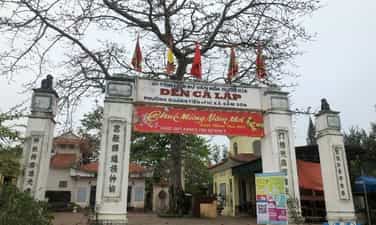
Ca Lap Temple
In addition to its folk name, Ca Lap temple (located in the ancient Ca Lap village) is also known by names such as: Tay Phuong Thanh Hoang temple of Quang Tien commune; Nghe An in Trap village, or the literal name is "Linh Tu General" - the temple worshiping the sacred general. However, although the names may be different, the relic is the place to worship the talented general whom Sam Son people have often called "Great General Tay Phuong" for many generations. Legend has it that his military career was closely linked to the resistance war against the Mongol invaders of the Tran dynasty and the ancient Dai Viet people. The relics of Ca Lap temple, after more than 700 years of construction and many restorations, are still preserved and protected by the people in the area, becoming a spiritual religious site that shows the admiration of the people of Sam Son coastal area for famous general. With its legend and existing value, in 1999 the Ca Lap temple relic was recognized by the Ministry of Culture and Sports as a National Monument. Source Department of Culture, Sports and Tourism of Thanh Hoa province.
Thanh Hoa
5174 view
Rating : National monument

Kenh Pagoda (Hung Phuc Pagoda)
Located in Hung Phuc Pagoda, also known as Kenh Pagoda (Quang Hung commune, Sam Son city), it was built in the late winter of the year Giap Ty, the reign of Khai Thai Nguyen (1324) during the reign of King Tran Minh Tong (1314-1329). ), the stele is the only original document recording a "fragrance" fighting under the Tran dynasty who united to defeat the invading Yuan-Mongol army led by Toa Do. The pagoda was built in Yen Duyen village to worship Buddha and worship Senior General Le An, who had great contributions in the first resistance war against the Yuan-Mongol army (in 1258), and was also promoted to general by King Tran Thai Tong. and marry the princess. As a general close to King Tran Quoc Tuan of Hung Dao, when he died, General Le An was awarded the royal title "Do Nguyen's Great Governor, Great Minister of the Country, Great General" - a very great title during the Tran Dynasty. . Stemming from a heart of compassion and filial piety, Le Bang - the second son of Lieutenant General Le An, started construction of the pagoda in 1264. The work was not completed when Le Bang died, and his second son, Le Manh, continued. Continue the work and rebuild the temple larger and more beautiful. In 1326, the pagoda was completed, consisting of 11 tiled buildings and two spacious courtyards, sitting on beautiful land that is both solemn and elegant. The pagoda was completely destroyed by the invading Ming army in the 15th century, leaving only the stele recording the victories of the Dai Viet army and people led by General Le Manh. Specifically, in 1285, Le Manh commanded the local militia to ambush the Toa Do army from the south, take a shortcut through Co Khe, enter Thanh Hoa, and win a major victory in the Co But region. That victory is engraved on a stele built in the pagoda, a precious relic of Ly - Tran culture. The stele is 1.5 m high, 0.6 m wide, 0.25 m thick, built on the back of a turtle with its legs stretched out and its neck stretched to the east. The stele's forehead is carved with two dragons flanking the sun, winding and strong. The dragon's body is plain and simple, typical of dragons of the Ly - Tran dynasties. The four words Hung Phuc Tu Trai are written in the style of a seal on the stele's forehead. The two sides are two button-shaped borders and the bottom is a highly stylized water wave. The stele was engraved in the year of the pagoda's inauguration, the 3rd year of Khai Thai (1326), by General Tran Quoc Chinh. This is one of only more than ten steles of the Tran Dynasty remaining in Vietnam. The epitaph has two parts: the upper part recounts the construction of the pagoda and recounts the achievements of Le Manh, the lower part is a 24-sentence poem praising the merits of the Le family. With the multifaceted historical, cultural, artistic and ideological value of the ancient stele, on September 4, 1995, the Ministry of Culture and Information (now the Ministry of Culture, Sports and Tourism) ranked National level Kenh Pagoda stele relic. Source Thanh Hoa province electronic information portal.
Thanh Hoa
5319 view
Rating : National monument

De Linh Temple
The temple is located on a high mound, and is said to be the burial place of him and his two daughters. The temple faces southwest, in front is a vast lotus field, in the distance is the gentle Do river flowing day and night to the sea. De Linh was from Bong Bao village, Vinh Hung commune (Vinh Loc), had an official title ranked among the four great court officials under the reign of King Le Tuong Duc (1510 - 1516), and was a man of superior intelligence and martial arts. According to history books, since the king assigned him to guard the vital area of Sam Son estuary, he has reclaimed land, trained soldiers, set up camps day and night to practice martial arts and take care of the peaceful and happy life of the people. should be highly praised by everyone. One time, the Ming army invaded our country by sea, they killed people and robbed land, General De Linh recruited soldiers to fight the enemy, but the situation was so uneven that they were isolated and there was no one to come to their aid in time, so the army We were besieged by the enemy. His two daughters wanted to avenge their father, so they led the army to relieve him. Father and son fought tenaciously until the last moment. Remembering the great contributions of General De Linh and his two daughters, the people built tombs and temples to honor the national hero day and night. The temple is located on high land that is said to be the sacred dragon's head, surrounded by beautiful, charming landscapes. De Linh's tomb is solidly built inside the temple. The tomb is covered with beautiful ancient stone layers. This place also preserves 9 ancient ordinations, considered local treasures. In addition, there are many ancient relics such as inscriptions, stone inscriptions, incense burners... Written tablets that are only hundreds of years old are also carefully preserved. On January 17 every year, local people hold incense offerings and hold wrestling festivals to remember their gratitude to the country's god, the founder of martial arts. Through many centuries with many ups and downs, the temple is still cared for and admired by the people. In 1993, the temple was recognized as a national historical and cultural relic. Source Thanh Hoa province electronic information portal.
Thanh Hoa
5339 view
Rating : National monument

To Hien Thanh Temple
Located on Truong Le mountain, To Hien Thanh temple is a famous ancient temple of Sam Son town in particular and Thanh Hoa province in general. The temple is also called the Second Temple or Trung Temple, is a temple in the system of three temples of Nui village or Sam Thon (Doc Cuoc Temple is the Upper Temple, the First Temple; Hoang Minh Tu Temple is the Third Temple or the First Temple). Ha). Legend has it that the temple has a history of over 800 years, and is the place to worship To Hien Thanh - the main mandarin of the Ly dynasty under the two dynasties of King Ly Anh Tong and Ly Cao Tong. He was a civil and martial officer, famous for his fairness and integrity, and was awarded the title of king by the king even though he was not a member of the Ly dynasty. Through historical ups and downs, the temple has undergone many restorations and new constructions. Currently, the temple has a Dinh-shaped structure, including 3 palaces: Bai Duong, Middle Duong and Hau Palace. The worshiping hall has three compartments to worship the community of mandarins, where ceremonies are held on festivals and his death anniversary... In the middle of the hall is a space where the altar and statue of Mr. To Hien Thanh are placed. The harem examined the saints and ordained them. The temple grounds are spacious and shaded by many trees. The ancient, mossy look of the temple. Source Thanh Hoa province electronic information portal.
Thanh Hoa
5138 view
Rating : National monument

Co Tien Temple
Co Tien Temple is located on top of Elephant's Head island at the end of Truong Le mountain range to the southwest. Elephant head stone is the fifth stone in the folk classification system. Its name is "Tuong Dau Son" which also means Elephant's Head Mountain, because the Truong Le mountain range running to this place suddenly protrudes a rock shaped like an elephant's head crouching to drink water. Co Tien Temple was built in the Ly Dynasty in an ancient architectural style, consisting of 3 layers: Front Street, Middle Duong and Hau Palace. Dinh-shaped architectural style (or mallet-shaped architecture). Through many degrees of rain, sun, wind and storms and the devastation of war, the temple was seriously damaged. The temple has been restored many times. In the 90s of the twentieth century, the Sam Son City Monuments Management Board repaired a number of items. The most recent renovation in 2010, Sam Son City restored the entire temple but still retained its ancient features. Funding for the construction of the Temple came from donations from people and tourists from all over. The temple was ranked as a National Monument in 1962. Source: Thanh Hoa Provincial Information Portal.
Thanh Hoa
5273 view
Rating : National monument

Doc Cuoc Temple
Doc Cuoc Temple is a temple dedicated to the god of the same name, a deity in Vietnamese folk beliefs. Doc Cuoc Temple is located on the top of a mountain named Co Giai island in the Truong Le mountain range in Sam Son city, Thanh Hoa province, right next to Sam Son beach. The temple was built during the Tran Dynasty and was restored many times during the Le Dynasty. The path to the temple is 45 stone steps. The wooden statue of Doc Cuoc god has only one arm and one leg. Behind the temple is Mon Lau built in 1863 with wood. In 1962, the temple was ranked as a national monument by the Ministry of Culture and Information of Vietnam. Source Thanh Hoa province electronic information portal.
Thanh Hoa
5780 view
Rating : National monument

God Emperor Temple
Than Hoang Temple in Coc Pai town has an area of nearly 4,000 square meters, built in the style of an ancient stilt house, with 3 compartments, 2 left with 2 stairs up and down; The total floor area is over 250m2, including the following items: The shrine is designed in the same style as the One Pillar Pagoda (Hanoi), poured with flat concrete, 3 gabled walls, red-tiled tiled roof, high quality. porcelain material; The Temple yard was built in 2010, cemented, 13m long, 2.5m wide, from the yard to the Temple there are 12 steps; On the upper floor, there is a statue of Quan Them, on the lower floor, there is an incense bowl to worship the local people...; Leaning against the mountain, facing south, there is a pair of beautiful stone dragons. The temple was built at a value of over 3.73 billion VND according to socialized capital, with Gia Long Co., Ltd. - the proactive unit that restored the monument - contributing 2.9 billion. This is the place to worship Mr. Hoang Van Thung, a son of the Xin Man people who publicly donated land, organized villagers to do business, and guarded the border many centuries ago... Every year, the people Organize a ceremony to commemorate Mr. Hoang Van Thung, considered the village God Emperor, on the first Dragon day of the Dragon month (3rd lunar month) with solemn folk rituals. On November 30, 2011, the Provincial People's Committee issued Decision No. 2644/QD -UBND recognizing Than Hoang Temple as a Provincial Historical-Cultural Relic. Source Ha Giang province electronic information portal.
Tuyen Quang
5444 view
Rating : Provincial level relics